





Trump to market Alaska LNG to Asian governments
US President Donald Trump's Energy Security Council plans to host a summit in Alaska in early June to sell the Alaska LNG project.
Bangladesh to renew LNG supply deal with Qatar - build new terminals
Qatar is to renew a recently expired memorandum of understanding (MoU) with Bangladesh for LNG supply.
YPF to opt for FLNGs
Argentina's state-run energy company, YPF has ruled out the building of an onshore natural gas liquefaction plant instead relying on FLNGs, the company’s CEO said in an interview with local media last week.
In the interview with Diario Rio Negro, CEO, Horacio Marin said there would be no onshore plant and the three-phased plan to export LNG would be undertaken through FLNGs.
"The time frames are much faster than on a land-based plant, and they're all turnkey projects so you know exactly what they will cost," Marin said.
YPF is the lead developer of Argentina's Vaca Muerta oil and gas field, an area the size of Belgium, which holds the world's second-largest shale gas and fourth largest shale oil reserves.
Under the banner of the Southern Energy Project, a company formed by YPF and its partners, plans are underway to start up Argentina's first floating liquefaction unit in 2027 with a capacity of 11.5 mill cu m per day, and also add another unit in the following year.
YPF has also signed a deal with Shell under which the UK energy major will participate in the production, liquefaction and sale of LNG.
In addition, the company also recently signed a memorandum of understanding (MoU) with Italy's Eni to develop upstream LNG facilities, including the shipments to two floating liquefaction facilities of around 6 mill tonnes per year.
Australian elections - Japan holds its breath
Japanese LNG importers are facing up to the possibility that long-term supplies from Australia could become uncertain.
EU’s US LNG imports rise - Russian supply falls
Deliveries of US LNG to the European Union were up by nearly 20% year-on-year during April, new data revealed.
Woodside takes Louisiana LNG FID
Woodside Energy Group has taken a final investment decision (FID) to develop the three train, 16.5 mill tonnes per annum Louisiana LNG development, formerly known as Driftwood.
The company said it had targeted first LNG in 2029.
Development of Louisiana LNG will position Woodside as a global LNG powerhouse, enabling the company to deliver around 24 mill tonnes per annum from its global LNG portfolio in the 2030s, and operating over 5% of global LNG supply, Woodside claimed.
Louisiana LNG also has the capacity to expand by adding another two LNG trains and is fully permitted for a total of 27.6 mill tonnes per annum.
Woodside also said that the project represented a compelling investment that will deliver significant cash flow and create long-term value for its shareholders.
It exceeds Woodside’s capital allocation targets, delivering an internal rate of return (IRR) above 13% and a payback period of seven years.
At full capacity, the project is expected to generate around $2 bill of annual net operating cash in the 2030s, driving Woodside’s next phase of value creation, giving the company’s global portfolio the potential to generate over $8 bill of annual net operating cash in the 2030s.
The forecast total capital expenditure for the LNG project, pipeline and management reserve is $17.5 bill. As an investor, Stonepeak, will provide $5.7 bill towards the expected capital expenditure for the project on an accelerated basis, contributing 75% of capital expenditure in both 2025 and 2026.
Woodside’s share of forecast total capital expenditure is $11.8 bill.
The company also said that its greenhouse gas emissions reduction targets remain unchanged by the Louisiana LNG FID.
CEO, Meg O’Neill said: “Louisiana LNG is a game-changer for Woodside, set to position our company as a global LNG powerhouse and enable us to deliver enduring shareholder returns.”
Louisiana LNG’s project cost of $15.9 bill, or $960 per tonne, includes EPC, owner’s cost and contingency costs. Pipeline cost is $1.1 bill.
It was recently rumoured that Woodside was looking to sell Louisiana LNG or at least a stake in the project.
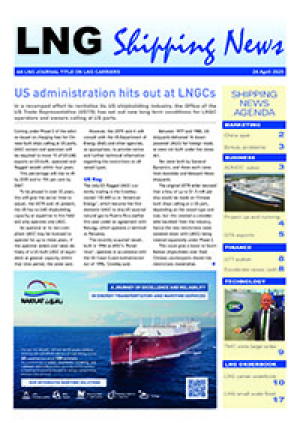
LNG Shipping News - 24 Apr 2025
Click to Download
US administration hits out at LNGCs
In a revamped effort to revitalise its US shipbuilding industry, the Office of the US Trade Representative (USTR) has set out new long term conditions for LNGC operators and owners calling at US ports.
China ditches US LNG
China completely stopped purchasing US LNG on 10th February, following the introduction of a 15% tariff on LNG imports, according to ship tracking data.
Data from China’s customs service showed that Chinese US LNG imports had already fallen during between November, 2024 and January this year.
At the same time, China has increased its gas purchases from Russia, which last year delivered four times more LNG to the country than the US.
Only two LNGCs from the US were en route to China when Beijing imposed tariffs on US fossil fuels in response to the initial round of 10% tariffs on Chinese goods introduced by US President Donald Trump earlier this year.
According to information provider, Kpler, one vessel arrived in China before the tariffs took effect and discharged its cargo, while the other was diverted to Bangladesh.
Drewry Maritime Research said in a recent report that China’s increasing domestic production, robust Russian gas supplies via the Power of Siberia pipeline and lower imports in 1Q25 (down 24% year-on-year) played a crucial role in supporting the country’s stance against US LNG.
Other suppliers
China’s reliance on other suppliers, such as Qatar, Russia, and Australia, will increase further, once its demand rises.
This will dent shipping demand since longer US/Asia voyages (via Cape of Good Hope) will see a decline. About 80-90 shipments from the US to China via the Cape route will be affected if an elongated trade war transpires, Drewry calculated.
If the US/China trade persists, about 80 bill tonne/miles will be generated (considering US/China voyages via COGH).
However, if China takes more LNG from Qatar, Australia and Russia, the total tonne/miles generated would be around 35 bill, indicating a potential loss of 45 bill tonne/miles for LNGCs (some 45-50 LNG shipments).
Europe is increasingly receiving LNG from the US and China, so its LNG prices should ease. However, this could be challenged, once the continent’s demand subsides, as Europe’s restocking season ends and China’s domestic LNG demand soars, especially during this summer and if the Chinese economy revives.
According to Drewry’s contracts database, China had secured considerable contractual capacity with the US since 2021, signing about 18 medium-to long-term sale and purchase agreements (SPAs) (totalling 28 mill tonnes per annum) with extended supplies until 2040.
In addition, due to the tariff wars, the US economy could face higher inflation, which could derail the pace and financing for planned LNG projects, despite regulatory easing following Trump's lifting of the pause on US LNG export permits and licenses.
While in the short term, the impact of the US/China trade war will have a limited effect on LNG shipping rates, rising tariff tensions could increase fears of a global recession, dampening project developments and threatening future capacities.
This could put the future of LNG shipping at a significant risk, denting the expected recovery in rates towards 2027/28.
Any rate recovery largely hinges on 1) anticipated liquefaction capacity addition, with the US commanding the largest share in planned volumes, 2) increased Asian LNG demand, buoyed by lower prices and 3) expanded US/Asia trade, given contracting activities in the recent years, Drewry said.
Chinese customs figures showed that LNG imports into China declined by 24.5% in March, compared to the same month in 2024, while pipeline gas increased by 2%.
In total, China imported 9.2 mill tonnes of LNG and pipeline gas during the month.
Bintulu problems hit freight rates
Global LNG freight fell sharply last week, as at least three of the nine trains at Malaysia’s Bintulu LNG were temporarily down, due to technical issues.



