





Avenir plans continuous bioLNG bunkering ops
Fuelling specialist Avenir LNG has announced plans to operate the first bunker vessel continuously on bio-LNG.
Axpo expands LNG Bunkering in Algeciras
International energy company Axpo has announced a major milestone in its LNG bunkering operations, with the successful completion of its first ship-to-ship LNG delivery in the Port of Algeciras.
AD Ports completes LNG bunkering first at Khalifa
Integrated maritime operator AD Ports Group has competed its first ship-to-ship LNG bunkering operation at Khalifa Port, paving the way for increased uptake of the fuel in the region.
The transfer was carried out between the bunker vessel Green Zeebrugge and the container vessel MSC Thais, while at berth in Abu Dhabi Terminals. Fuel for the bunkering procedure was supplied by marine fuels provider Monjasa.
“By adhering to the highest safety and environmental standards, AD Ports Group and Monjasa are ensuring that shipowners have reliable access to a diversified fuel mix that supports their decarbonisation objectives,” Captain Saif Al Mheiri, Chief Sustainability Officer at AD Ports Group, said. “AD Ports Group will continue to explore and implement forward-looking solutions that drive progress toward global sustainability goals.”
Bunkering expansion
The operation was hailed as a landmark for regional development of LNG bunkering, with Abu Dhabi keen to position itself as a key hub for alternative marine fuels and sustainable maritime solutions.
“With this achievement, AD Ports Group is accelerating the shift toward sustainable marine fuels, while reinforcing Abu Dhabi’s leadership in the global energy transition,” a spokesperson for the firm said.
AD Ports Group and Monjasa have announced that they will continue to expand LNG bunkering services across the Group’s commercial ports in Abu Dhabi, including cruise vessels at Zayed Port.
Alongside LNG, the firms will continue to offer a comprehensive fuel portfolio in the medium-term, including Very Low Sulphur Fuel Oil (VLSFO), Marine Gas Oil (MGO), and High-Sulfur Fuel Oil (HSFO).
Net Zero strategy
Longer-term the partners are keen to explore lower carbon alternatives, with plans to invest in new frameworks to support a wider range of fuel options as well as advancing LNG bunkering protocols and guidelines.
The UAE is also exploring new legislation to promote clean fuel bunkering as part of the UAE’s Net Zero 2050 Strategy. This framework aims to build on policy from the International Maritime Organization (IMO), International Association of Ports and Harbors (IAPH), International Organization for Standardization (ISO), and Society of International Gas Tanker and Terminal Operators (SIGTTO) amongst others to establish the UAE as a go-to hub for LNG and clean fuel pathways.
Headquartered in Abu Dhabi, AD Ports Group operates across five key clusters – Digital, Economic Cities & Free Zones, Logistics, Maritime & Shipping, and Ports. The group operates in 38 locations globally and is one of the Gulf region’s largest holding companies.
GreenLine, Bekaert partner on LNG pilot project
Sustainable trucking group GreenLine Mobility Solutions has partnered with tire reinforcement specialist Bekaert to decarbonise road logistics in India.
LNG Unlimited – 1 May 2025
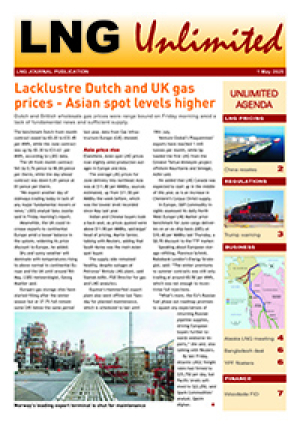
Click to Download
Lacklustre Dutch and UK gas prices - Asian spot levels higher
Dutch and British wholesale gas prices were range bound on Friday morning amid a lack of fundamental news and sufficient supply.
The benchmark Dutch front-month contract eased by €0.20 to €33.45 per MWh, while the June contract was up by €0.30 to €33.63 per MWh, according to LSEG data.
The UK front-month contract fell by 0.76 pence to 80.84 pence per therm, while the day-ahead contract was down 0.81 pence at 81 pence per therm.
"We expect another day of sideways trading today in lack of any major fundamental movers or news," LSEG analyst Saku Jussila said in Friday morning’s report.
Meanwhile, the UK could increase exports to continental Europe amid a looser balance in the system, widening its price discount to Europe, he added.
Dry and sunny weather will dominate with temperatures rising to above normal in continental Europe and the UK until around 5th May, LSEG meteorologist, Georg Mueller said.
Europe's gas storage sites have started filling after the winter season but at 37.7% full remain some 24% below the same period last year, data from Gas Infrastructure Europe (GIE) showed.
Asia price rise
Elsewhere, Asian spot LNG prices rose slightly amid production outages in Europe and Asia.
The average LNG prices for June delivery into northeast Asia was at $11.80 per MMBtu, sources estimated, up from $11.50 per MMBtu the week before, which was the lowest level recorded since May last year.
Indian and Chinese buyers took a back seat, as prices quoted were above $11.90 per MMBtu, said Argus’ head of pricing, Martin Senior, talking with Reuters, adding that South Korea was the main Asian spot buyer.
The supply side remained healthy, despite outages at Petronas’ Bintulu LNG plant, said Siamak Adibi, FGE Director for gas and LNG analytics.
Equinor's Hammerfest export plant also went offline last Tuesday for planned maintenance, which is scheduled to last until 19th July.
Venture Global’s Plaquemines’ exports have reached 1 mill tonnes per month, while bp loaded the first LNG from the Greater Tortue Ahmeyim project offshore Mauritania and Senegal, Adibi said.
He added that LNG Canada was expected to start up in the middle of this year, as is an increase in Cheniere’s Corpus Christi supply.
In Europe, S&P Commodity Insights assesssed its daily North West Europe LNG Marker price benchmark for June cargo deliveries on an ex-ship basis (DES) at $10.40 per MMBtu last Thursday, a $0.70 discount to the TTF marker.
Speaking about European storage refilling, Florence Schmit, Rabobank London’s Energy Strategist, said: “The winter premiums to summer contracts was still only trading at around €0.50 per MWh, which was not enough to incentivise full injections.
“What’s more, the EU’s Russian fuel phase out roadmap promises to squash any expectations of returning Russian pipeline supplies, driving European buyers further towards seaborne imports,“ she said, also talking with Reuters.
By last Friday, Atlantic LNGC freight rates had firmed to $35,750 per day, but Pacific levels softened to $22,250, said Spark Commodities’ analyst, Qasim Afghan.
EU gas storage rules to be amended
Last week, a European Parliament committee voted for the lowering of gas storage targets.
China records highest LNG re-sales this month
China has set a new record for LNG re-exports, shipping out more than 280,000 tonnes in April, the highest volume ever recorded for a single month.
US LNG industry attacks Trump’s new rules for ships
The US LNG sector has raised concerns with the Trump administration over the latest regulations against Chinese operated and Chinese built ships, saying that the industry cannot meet the requirement to move to US-flagged ships without significant disruption, the UK’s Financial Times reported on Sunday.
In letters sent to US government departments last week by the American Petroleum Institute (API), industry leaders warned that the rules, unveiled by US trade representative, Jamieson Greer on 17th April, could jeopardise a $34 bill annual export market.
Although the LNG industry has secured a three-year grace period to delay compliance, the rules still require companies to transition to US-built and US-flagged ships phased over a 22-year timeline.
Failure to comply could result in the suspension of export licenses.
API’s letter addressed to the US Secretaries of Energy and the Interior stress that the LNG sector has no realistic way to meet the deadline.
Sources talking with the media outlet claimed that the US currently lacks both LNG-capable ships and the shipyard capacity needed to build them in time for the 2029 deadline.
In its letter, the API warned that enforcing these rules would erode US leadership in the global LNG market and weaken its broader standing as an energy superpower.
The organisation also expressed concern that future administrations might weaponise similar trade mechanisms to halt energy exports.
After overtaking Australia in 2023, the US is now the world’s leading LNG exporter, shipping 11.9 bill cu ft per day, enough to meet the combined natural gas demand of Germany and France. In addition, the US aims to double its exports by the end of this decade.
Law firm, Watson Farley Williams explained that in Annex IV – Restriction on LNG exports - of the recirculated rules, starting on 17th April, 2028, at least 1% of all LNG intended for export by ship in a calendar year must be shipped on a US-built vessel.
This percentage increases annually from 2029, plateauing at 15% in April, 2047.
The restrictions on LNG exports will be suspended for up to three years, if the vessel owner orders and takes delivery of a US-built vessel of equivalent or greater capacity during the first period.
This suspension does not apply to Chinese-owned or leased vessels.
LNGCs will be also exempt from the other fees to be levied on Chinese built and owned vessels.
India steers away from LNG
Indian energy importers have reduced the volume of LNG purchased from abroad in favour of oil products, due to rising prices.



