





LNG modules start to arrive at Woodfibre
Canada’s Woodfibre LNG project reached a major construction milestone on 24th May with the arrival of the first seven specialist LNG modules.
DET commissions second Wilhelmshaven terminal
With the commissioning of the third floating LNG import terminal and the second in Wilhelmshaven on 26th May, German state-owned Deutsche Energy Terminal GmbH (DET) implemented another key project of the LNG Acceleration Act.
Gas to Power – May 23, 2025
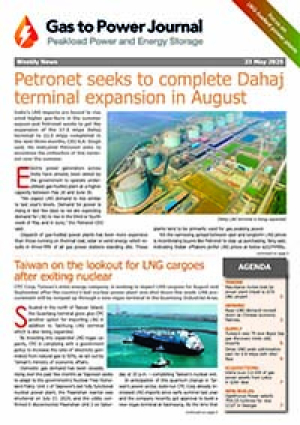
Click to Download
Gas to Power – May 16, 2025
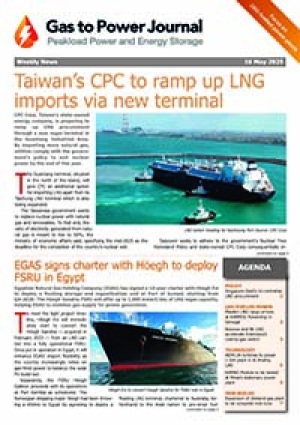
Click to Download
LNG Unlimited – 15 May 2025
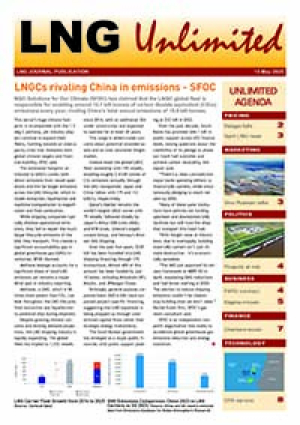
Click to Download
LNGCs rivaling China in emissions - SFOC
NGO Solutions for Our Climate (SFOC) has claimed that the LNGC global fleet is responsible for enabling around 12.7 bill tonnes of carbon dioxide equivalent (CO₂e) emissions every year, rivaling China’s total annual emissions of 15.9 bill tonnes.
US natgas prices fall
US natural gas futures fell around 4% on Monday on a rise in output, coupled with a decline in gas flows to LNG export plants.
The price drop came despite forecasts for more demand this week than previously expected.
Gas futures for June delivery on the New York Mercantile Exchange (NYMEX) fell 14.9 cents, or 3.9%, to settle at $3.646 per MMBtu. On Friday, the contract closed at its highest since 9th April.
However, with futures up about 29% over the previous two weeks, speculators last week boosted their net long NYMEX futures and options positions and Intercontinental exchanges for the first time in nine weeks, according to the US Commodity Futures Trading Commission's Commitments of Traders report.
Analysts, speaking with Reuters, said mostly mild weather should keep heating and cooling demand low in the coming week, allowing utilities to continue injecting more gas into storage than normal for this time of year.
Gas stockpiles were already about 3% above the five-year (2020/2024) normal.
Financial firm LSEG said average gas output in the Lower 48 US states fell to 103.7 bill cu ft per day thus far in May, down from a monthly record of 105.8 bill in April.
On a daily basis, gas output was on track to slip to a preliminary 103.4 bill cu ft per day on Monday, down from a one-week high of 104.4 bill on 10th May and up from a 10-week low of 102.7 bill on 6th May.
That compares with a daily record high of 107.4 bill cu ft per day on 18th April.
Looking ahead, analysts said the roughly 11% drop in US crude futures thus far this year should prompt drillers to cut back on oil production.
Any decline in oil production would ultimately reduce the amount of gas extracted that is associated with the oil output. About 37% of US gas production comes from associated gas, according to federal energy data.
Over time, analysts said any reduction in associated gas output should increase gas prices.
Meteorologists projected temperatures in the Lower 48 states would remain mostly warmer than normal through 27th May.
With warmer weather starting to boost air conditioning use, LSEG forecast average gas demand in the Lower 48, including exports, will rise from 97 bill cu ft per day this week to 98.2 bill next week.
The average amount of gas flowing to the eight big LNG export plants operating in the US fell to $15.1 bill cu ft per day thus far this month, down from a monthly record of 16 bill cu ft in April.
The LNG feedgas decline this month was mostly due to reductions for maintenance at Cameron LNG's 2 bill cu ft per day plant in Louisiana and Cheniere Energy's 3.9 bill cu ft Corpus Christi plant under construction and in operation in Texas, and a one-day outage at Freeport LNG's 2.1 bill cu ft plant in Texas on 6th May.
Asian spot LNG prices firm
Asian LNG spot prices rose slightly last week, tracking European gas prices, which gained ground following the EU's plan to phase out Russian gas.
Russia and China in LNG project investment talks
Chinese companies' involvement in Russian LNG projects was discussed by Russian and Chinese delegations in Moscow last Thursday, the Interfax news agency reported, quoting Russian Energy Minister, Sergei Tsivilev.
Changing Russian gas restrictions could impact US LNG projects
The US, which currently supplies half of Europe's LNG imports and roughly 15% of the continent's total gas supply, would be disproportionately impacted if current restrictions on Russian gas and LNG were to change, according to a S&P Global Commodity Insights study.
The report, ‘US LNG Exports at Risk: Potential Unwinding of Sanctions on Russian Natural Gas’ said that, under an ‘Opening the Taps’ scenario where US sanctions on Russian natural gas pipeline and LNG exports were lifted and new volumes of Russian gas flowed into Europe, more than 17 mill tonnes per annum in new US LNG projects — representing $70 bill in related investment — would be curtailed, compared to the ‘Current Trend’ scenario.
Conversely, an increasing ‘Phasing Down’ scenario on Russian LNG and most piped gas, largely consistent with the EU Commission's REPowerEU Roadmap published on 6th May, would result in an additional 12 mill tonnes in US LNG projects reaching final investment decision (FID), representing an additional $48 bill in investment.
The difference between the ‘Opening the Taps’ and ‘Phasing Down’ scenarios represented 29 mill tonnes per annum in US LNG project FIDs and nearly $120 bill in related investment impact.
"Any changes to restrictions on Russian gas flows to Europe would dramatically impact US LNG in market share and investment," said Carlos Pascual, Senior Vice President, Global Energy, S&P Global Commodity Insights.
"On the downside, unwinding Russia sanctions would reduce the market for US LNG, curtailing investment in future US projects and simultaneously undermining European efforts to diversify gas imports," he said.
US LNG is disproportionately impacted across the scenarios given its nature as the balancing supply for global LNG markets. Its contractual structures and US market liquidity mean that it reacts more quickly to price signals.
Given the volatility seen in policy on gas exports and imports, European policy decisions could evolve over time depending on wider political circumstances in Europe and globally, thus validating all three potential scenario outcomes, the report said.



