





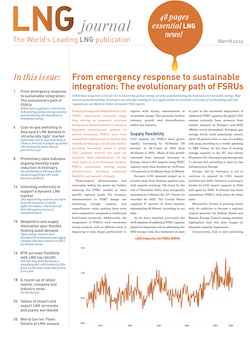
LEAD STORY
From emergency response to sustainable integration: The evolutionary path of FSRUs
Written by AJ KotzeFSRUs have acquired a critical role in bolstering global energy security and facilitating the transition to renewable energy. That success notwithstanding, developers are already looking for new applications to overcome criticisms of overbuilding and new regulations, our Markets Editor Alexander Wilk reports.
Coal-to-gas switching in Asia spurs LNG demand in a ‘structurally tight’ market
Written by AJ KotzeIndustrial coal-to-gas switching in China, as well as rising gas imports for power generation in South and Southeast Asia, is forecast to propel up global LNG demand by more than 50 percent by 2040. But the market is “still structurally tight,” Shell cautioned as fragility of supply and price volatility continues; our Markets Editor Anja Karl has more.
Also in this issue
Preliminary data indicates ongoing monthly trade reduction in February
Written by AJ KotzeOur preliminary February data showed a significant LNG trade decrease globally. Whilst the scale of the reduction remains subject to change as the month progresses, it nonetheless announces the likely direction come month-end, our Market Editor Alexander Wilk reports.
Unlocking uniformity to support a dynamic LNG market
Written by AJ KotzeFrom Microsoft operating platforms to Wi-Fi, and even debit card processing, LNG engineering systems can learn from the evolution of these vastly different entities, which have all been through a process of standardisation.*
Geopolitics and supply dislocation spur flexible floating asset demand
Written by AJ KotzeTight energy markets have benefited from demand and supply changes that have had a knock-on effect for mobile assets, writes Tor-Ivar Guttulsrod, Director FSRU & FLNG, Global Gas Solutions, ABS Europe.
LNG has long been hailed as a transition fuel, with relatively little focus on the exact steps that follow it as a fuel. However, as new bunker capacity emerges for alternative fuels many operators are now exploring means to retrofit existing LNG vessels and prepare for future demand. Fuelling Editor Malcolm Ramsay has more.
A round-up of latest events, company and industry news
Written by AJ KotzeABS, the American Bureau of Shipping maritime classification society, has inaugurated an ABS Global LNG Academy in the Qatari capital Doha and dedicated to training and educating mariners in modern LNG vessel operations.



