





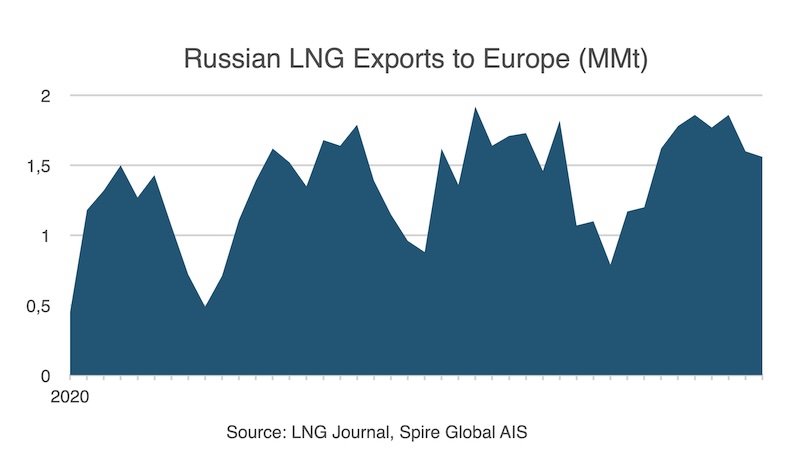
In its latest sanctions package on Russia, the EU has introduced new sweeping measures aimed at curtailing cash and asset flows in and out of the country. For the first time, some of these measures, which will come into force in nine months’ time – are also directly targeted at Russian LNG exports. The country’s LNG flows to the EU have gained in significance since late 2020, with shipments during the first five months this year up almost 30pct over their 2021 equivalent. However, with Russia’s Atlantic Basin production at capacity, annual growth stalled in 2023, according to our data.
The European Union has adopted its 14th package of sanctions against Russia, introducing significant measures targeting the country’s LNG exports for the first time.
These new restrictions aim to curb Russia's revenue from LNG by banning trans-shipments, which involve transferring LNG cargoes from one ship to another at EU ports.
Additionally, Sweden and Finland now have the authority to cancel certain LNG contracts, further tightening the constraints on Russia's gas exports.
Transition period
The sanctions, which will come into effect after a nine-month transition period, also prohibit new investments and services aimed at completing LNG projects – most notably Artic LNG 2 – currently under construction in Russia.
Despite these stringent measures, experts predict only a modest impact on Russian LNG exports, as Europe continues to import Russian gas and trans-shipments via EU ports constitute but a small fraction of Russia's total LNG exports.
Consequently, the financial hit on Russia is estimated to be in the millions of euros rather than billions.
SPFS ban
A more potent sting may come from a new measure that bans EU banks outside Russia from using Moscow's SPFS system, an alternative to the global SWIFT payments system.
Non-Russian third-country banks connected to SPFS may also be prohibited from conducting business with EU operators.
The sanctions package also aims to crack down on the so-called shadow fleet, which, inter alia, is thought to have been used to transport sanctioned LNG components.
Initially, 27 ships, mostly tankers, are to be listed under these new restrictions, with more to follow.
Export increase
Seasonal Russian LNG exports to Europe have continued to grow since 2020, although this growth has slowed each year since an initial boost at the beginning of 2022.
LNG flows during the first five months of the year amounted to 8.65mmt, according to our data, up 0.29mmt (3pct) from the 8.36mmt we recorded during the same period last year.
Compared to 2021, that difference is even more pronounced with growth of 1.95mmt (29pct) from 6.70mmt. Underpinning that growth is Yamal LNG, which has been producing well above nameplate capacity.
The commissioning of Gazprom’s Portovaya facility in Baltic has also helped.
However, with both active Russian LNG plants operating above or close to nameplate capacity, annual growth stalled in 2023, with exports to Europe down marginally by 0.17mmt (-0.9pct) to 17.09mmt from 17.26mmt in 2022.




