





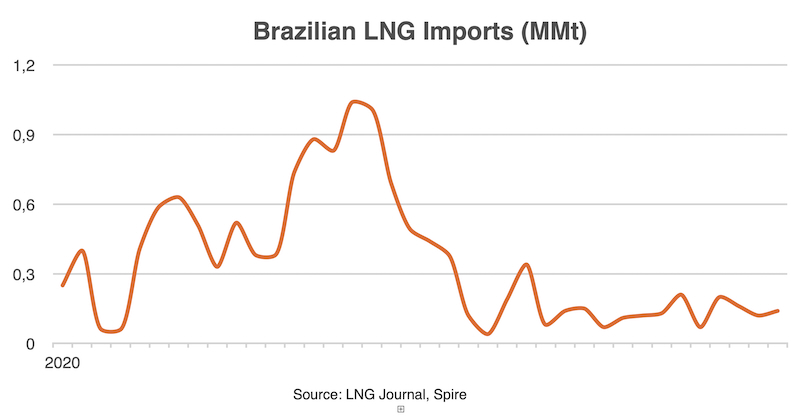
New Fortress Energy announced last week that its new Terminal Gas Sul FSRU terminals had arrived on site and was operational. The company expects the facility to become instrumental in the reliable energy supply to Brazil’s southern region. According to our data, LNG flows to Brazil already stood at almost half those for the whole year of 2023 and the inauguration of new import capacity could accelerate that growth. Although Brazil’s LNG imports have tumbled since their weather-induced peak 2021, they have been growing again.
New Fortress Energy has successfully commenced operations at its Terminal Gas Sul (TGS) LNG terminal situated in Santa Catarina, Brazil, with the deployment of the Energos Winter FSRU on-site, the company announced on Friday.
TGS, an offshore LNG import terminal boasting capacity of around 6.0 million tonnes per annum and a maximum send out of 500 mmscf/day, incorporates the Energos Winter FSRU and a 33-kilometer, 20-inch pipeline linking the facility to the existing inland Transportadora Brasileira Gasoduto Bolívia-Brasil (TBG) pipeline.
Facility milestone
The establishment of TGS marks a significant milestone for New Fortress Energy, presenting a promising avenue for growth within the Brazilian power and gas sectors.
The company highlighted the terminal's strategic importance in supplying the regional market with feedgas.
The terminal’s connection via pipeline could reach over 3.5GW of power capacity previously in need of firm, long-term gas supply agreements, and the equivalent of over 300 TBtu of industrial and residential gas consumers in the southern region of Brazil.
Important infrastructure
Both power and gas demand in the region are poised for substantial growth.
Previous protracted periods of drought that hampered the production of hydroelectricity coupled with the anticipated decline in the historical gas supply from Bolivia mean the TGS terminal stands to obtains a critical role in fulfilling the area's energy needs, Wes Edens, Chair and CEO of New Fortress Energy, emphasised.
Edens further highlighted the terminal's significance by stating, "With several new power projects required to stabilize the grid in Brazil in the near future, NFE is well-positioned to address the rising demand through its vertically integrated portfolio of LNG assets and expertise."
Demand growth
Brazil’s LNG demand tumbled from its heights of 7.80mmt in 2021 during a severe bought of drought brought on during a particular strong El Nino occurrence in 2021 to 0.84mmt in 2023, when higher levels of rainfall enabled sustained hydroelectricity production.
Nevertheless, the growing interest by smaller investors unrelated to Brazil’s national energy champion Petrobras in the country’s power market indicates future growth as quick-to-build terminals unlock power markets in Brazil’s more remote areas.
This is likely to expand the role of regional FSRU beyond providing back-up energy supply during periods of drought.
Indeed, in the year to date, LNG flows to Brazil already stood at almost half those for the whole year of 2023, according to our data.




