





Chinese state-backed firms have commissioned three new terminals this summer, namely Wenzhou LNG, Caofeidian Xintian LNG and Nansha LNG. Nansha LNG is the most recent but also the smallest addition to the country’s import capacity.
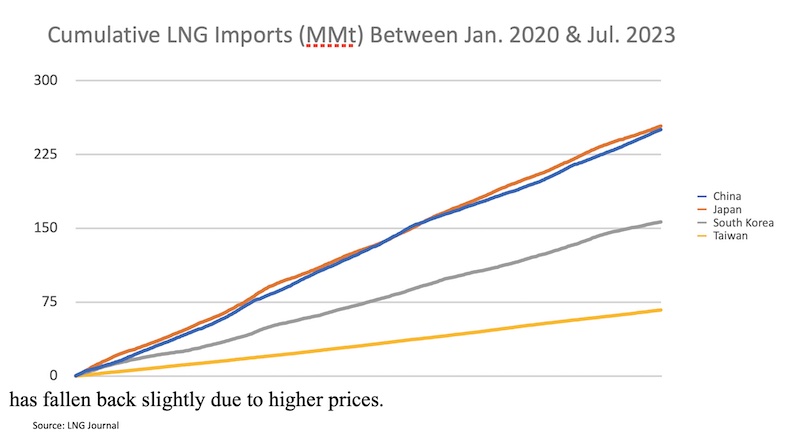
China has thus picked up its pace in the expansion of LNG capacity as it chases Japan for the highest cumulative LNG demand growth rate in the Far East since January 2020, according to our data. Chinese provincial and national Five-Year Plans push for significant steps in carbon intensity reduction in industry and an increase in the urban use of gas.
The new 1 million tonnes per annum (mtpa) Nansha LNG terminal in China’s Guangzhou Province has commenced Phase 1 operations after receiving its inaugural cargo on 8 August, our shipping data showed.
The LNG carrier Maran Gas Coronis delivered a 0.04mmt cargo to operator Guangzhou Gas, which it had loaded at ADNOC’s Das Island plant in the UAE on 8 June.
Major power provider
Guangzhou Gas is a subsidiary of state-owned power and gas provider Guangzhou Development Group, which manages a portfolio of 12 power stations in Guangdong Province, according to its website.
Positioned in Guangzhou on China's southern shoreline, Nansha LNG is the third import terminal to be operational in China for 2023, and it's the country's 26th conventional LNG terminal taking in cargoes from international markets.
Construction of the facility began in September 2019.
Chasing the top
Notably, the growth rate of China’s cumulative LNG imports has chased that of Japan since 2020, our data show. China’s growth rate briefly surpassed that of Japan in January 2022 but
Initially, Guangzhou Gas aimed to launch the Nansha LNG terminal at the end of June. However, the launch day was postponed due to last-minute government checks, according to a Guangzhou Gas representative speaking to Platts.
Sinochem, a state-owned entity and one of China's top four petrochemical enterprises, traded the cargo, the official further stated.
The size of Nansha LNG indicates the terminal will mainly be used for emergency peak-shaving services and thus forms an integral part of Guangdong Province’s 13th and 14th Five-Year Plans, which, inter alia, target a reduction in carbon intensity by 23 percent.
Two-stage development
Nansha LNG is being developed in two stages. Phase 1 currently in operation will provide LNG storage capacity of 320,000m3 and thereby be able to cover Guangzhou's emergency natural gas requirements for ten days.
Phase 2 will double this storage capacity to 640,000m3 and extend the emergency cover to 15 days, according to the Department of Emergency Management of Guangdong Province. However, Nansha LNG will only be able to accommodate vessel sizes up to 147,000m3.
Supply deals
Guangzhou Development penned a decade-long contract in March 2022 to purchase 0.40mtpa of LNG from Sinochem for deliveries spanning 2032.
Presumably, the amount forms part of Sinochem’s portfolio obtained under a 17.5-year agreement with US-based Cheniere in November 2021 to acquire up to 1.8mtpa until 2040.
Guangzhou Development also signed an agreement with Mexico Pacific for the purchase of 2.0mtpa for two decades from the Mexico Pacific's LNG export project, the plant’s developer announced in April 2022.
The 9.4mtpa Phase 1 of the Mexican export project is due to be commissioned in 2025, according to our database. BP will also be supplying approximately 0.65mtpa from 2022 and until 2034, whilst Guangzhou Development also has contracts with city gas enterprises in the Hong Kong-Macao Greater Bay Area, according to Platts.
The oversubscribing of supply suggests Guangzhou Development is hedging its bets should there be delays at the Mexico Pacific LNG project.
Additional capacity
Earlier this summer, China Suntien Green Energy Corp. began commercial operations at the 5.0mtpa Caofeidian Xintian LNG terminal adjacent to PetroChina’s facility on 18 June.
Zhejiang Energy Group, meanwhile, commissioned its 3.0mtpa Wenzhou LNG terminal 7 August via a 0.06mmt Bontang delivery aboard the Yari LNG.
Notably, judging by the LNG carrier’s AIS signal, start-up at Wenzhou was delayed by more than a month for reasons that were not clear at the time writing but may well have been similar to those affecting Nansha LNG.




