





Monthly Data Supplement - February 2026
Click to Download
February 2026 Monthly Data
Click to Download
Monthly Data - Feb 2026
Henry Hub spike hurts Atlantic-Pacific arbitrage as US cargoes flow to Europe
Market Tracker Supplement - 16 Feb 2026

Click to Download
Market Tracker - 16 February 2026
Click to Download
Qatar's North Field East Faces Another Delay
Qatar's latest timeline revision for the North Field East expansion, pushing first production to Q4 2026 at the earliest, reinforces that the much-anticipated LNG supply wave will build more slowly than markets had expected. With global inventories tight and a significant share of North Field capacity still lacking firm offtakers, the delay carries real market weight.
Back Issues 2026
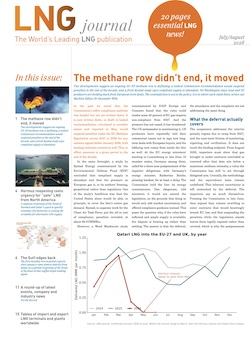
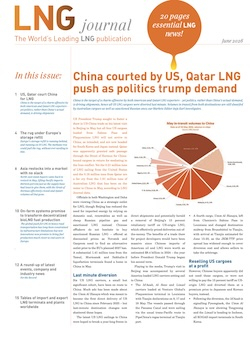
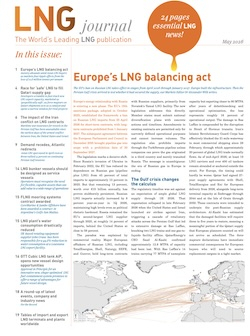
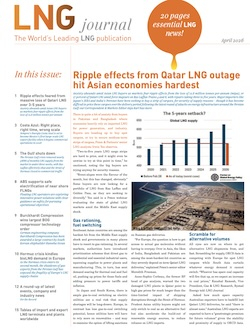
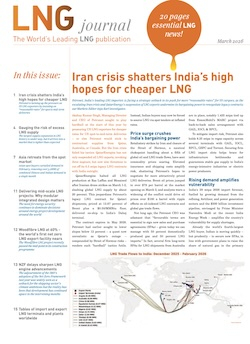
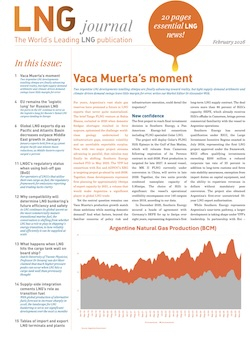
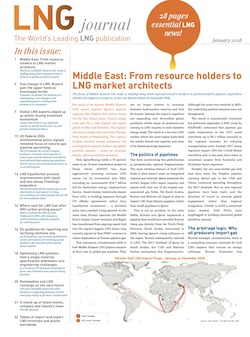
Back Issues 2025
| November/December 2025 | |
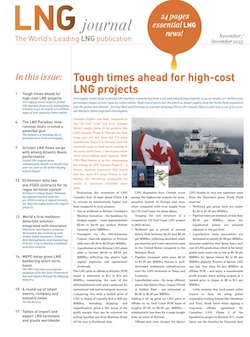 |
LEAD STORY |
|
Tough times ahead for high-cost LNG projects Oversupply looms large in global LNG markets commencing from 2026 and intensifying towards 2030, as nearly 200 million tons per annum (mtpa) of new capacity comes online. High-cost projects feel the pinch as Qatari supply from the North Field expansion sets the global benchmark – forcing Shell and Petronas to consider delaying FID on LNG Canada Phase 2 until late 2026, if not 2027; our Markets Editor Anja Karl investigates. |
|
|
Also in this issue The LNG Paradox: How rational deals created a potential glut October LNG flows surge with strong Atlantic Basin performance ECOonnect wins two pre-FEED contracts for its regas terminal system World’s first methane detection solution integrated with insurance |
|
| October 2025 | |
 |
LEAD STORY |
|
Europe accelerates Russian LNG exit amid timing uncertainty over new supply Markets project an LNG glut by 2026, yet traders are placing substantial bets on European gas price spikes. The disconnect reveals deep uncertainty about project timing, our Market Editor Dr Alexander Wilk reports. |
|
|
Also in this issue Power project delays free up feedgas for LNG Financing split emerges in US LNG boom September LNG flows ease as Pacific contraction offsets Atlantic growth |
|
| September 2025 | |
 |
LEAD STORY |
|
Europe’s energy pledge: Ambition meets market limits The EU's ambitious new pledge to purchase $250 billion worth of American energy annually faces significant practical obstacles from underlying market realities, our Markets Editor Dr Alexander Wilk reports. |
|
|
Also in this issue Middle East LNG export ambitions require over $50 billion in CAPEX July LNG flows surge despite weaker European demand Interview: Navantia discusses LNG ship repair and market outlook LNG heavies - a cause for concern European LNG terminals’ future – challenges, transformations, and strategic integration Supply chain optimisation poised to transform LNG fuelling sector |
|
| July/August 2025 | |
 |
LEAD STORY |
|
US LNG export dynamics in 2025: Market realignment and emerging opportunities Maintenance disruptions, evolving trade flows, and emerging market infrastructure challenges reveal the complexities behind America's LNG export growth, writes our Market Editor Dr Alexander Wilk. |
|
|
Also in this issue Distance to Asia – a distinct advantage of LNG Canada June LNG flows expand as Pacific, Middle Eastern growth offsets Atlantic decrease ECITB helps develop PNG LNG leadership safety skills Wison New Energies to drive intelligent FLNG designs with SUPCON |
|
| June 2025 | |
 |
LEAD STORY |
|
China's prolonged suspension of US LNG unravels global trade flows Global LNG trade flows – both spot cargoes and term deliveries – have to adapt to China's adamant stance towards US LNG imports: Policymakers in Beijing mandated China's state-dominated energy companies to stop importing US LNG imports since early February, with no easing in sight. The lost Chinese demand is forecast to slash the quarterly revenue of American LNG exporters by up to $3.8 billion, while oversupplied gas markets drive down prices in Asia as well as at the US Henry Hub. |
|
|
Also in this issue EU targets 2027 to end Russian LNG imports – Can new supply and policy fill the gap? Global LNG flows ease in May despite year-on-year growth INTERVIEW: TGE discusses LNG sector challenges and opportunities Securing LNG shipping in the age of the 'shadow fleet' |
|
| May 2025 | |
 |
LEAD STORY |
|
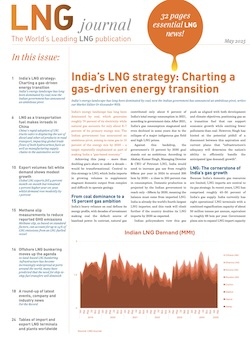
India's LNG strategy: Charting a gas-driven energy transition India's energy landscape has long been dominated by coal, which generates roughly 70 percent of its electricity while natural gas accounts for only about 6–7 percent of its primary energy mix. The Indian government has announced an ambitious pivot, aiming to raise gas to 15 percent of the energy mix by 2030 – a target repeatedly emphasised as part of making India a "gas-based economy." |
|
|
Also in this issue LNG as a transportation fuel makes inroads in China Export volumes fall while demand shows modest growth Methane slip measurements to reduce reported GHG emissions |
|
| April 2025 | |
 |
LEAD STORY |
|
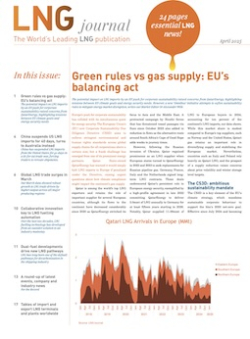
Green rules vs gas supply: EU’s balancing act The potential impact on LNG imports by an EU push for corporate sustainability raised concerns from QatarEnergy, highlighting tensions between EU climate goals and energy security needs. However, a new ‘Omnibus’ initiative attempts to soften sustainability rules to mitigate energy market disruption, writes our Market Editor Dr Alexander Wilk. |
|
|
Also in this issue China suspends US LNG imports for 40 days, turns to Australia instead Global LNG trade surges in March Helping LNGCs gain greater operating efficiency |
|
| March 2025 | |
 |
LEAD STORY |
|
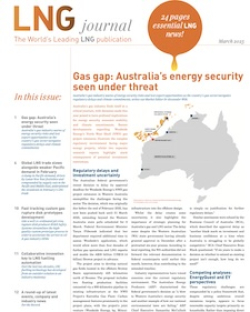
Gas gap: Australia's energy security seen under threat Australia's gas industry warns of energy security risks and lost export opportunities as the country's gas sector navigates regulatory delays and climate commitments, writes our Market Editor Dr Alexander Wilk. |
|
|
Also in this issue Global LNG trade slows alongside weaker Pacific demand in February Fast tracking custom gas rupture disk prototypes development |
|
| February 2025 | |
 |
LEAD STORY |
|
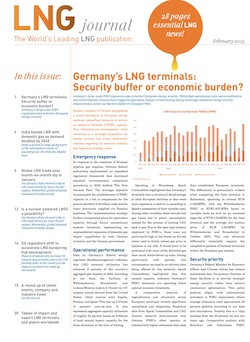
Germany's LNG terminals: Security buffer or economic burden? Germany's large-scale FSRU expansion aims to bolster European energy security. Whilst high operational costs, uneven utilisation and environmental concerns have triggered opposition, Europe's transitioning energy landscape mandates energy security enhancements, writes our Markets Editor Dr Alexander Wilk. |
|
|
Also in this issue India blends LNG with domestic gas as demand doubles by 2040 Global LNG trade sees month-on-month dip in January Is a nuclear powered LNGC a possibility? US regulatory shift to accelerate LNG bunkering hub development |
|
| January 2025 | |
 |
LEAD STORY |
|
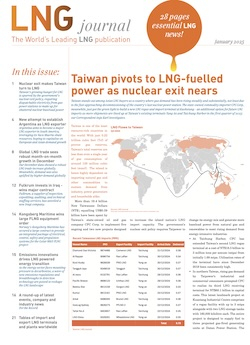
Taiwan pivots to LNG-fuelled power as nuclear exit nears Taiwan stands out among Asian LNG buyers as a country where gas demand has been rising steadily and substantially, not least due to the fast-approaching decommissioning of the country's last nuclear power station. The state-owned commodity importer CPC Corp, meanwhile, just got the green light to build a new LNG regas and import terminal at Kaohsiung – an additional option for future LNG imports as more shipments are lined up at Taiwan's existing terminals Yung An and Taichung Harbor in the first quarter of 2025; our Correspondent Anja Karl investigates. |
|
|
Also in this issue New attempt to establish Argentina as LNG exporter Global LNG trade sees robust month-on-month growth in December Fulkrum invests in Iraq - wins major contract Synectics introduces oil and gas facilities' risk protection |
|
Vaca Muerta’s moment
Two Argentine LNG developments totalling 18mtpa are finally advancing toward reality, but tight supply-demand arithmetic and climate-driven demand swings leave little margin for error, writes our Market Editor Dr Alexander Wilk.
EU remains the ‘logistic lung’ for Russian LNG
Six ports in the EU – Zeebrugge, Dunkirk and Montoir-de-Bretange, Bilbao, Mugardos and Rotterdam – continue to serve as the logistics lung for Russia’s Yamal LNG cargoes landing in Europe. Unphased by Brussels’ full ban on Russian LNG from 2027, European buyers spent more than €7.2 billion on cargoes from Yamal last year. A ban on re-exports had little effect, it merely shifted trade patterns; our Markets Editor Anja Karl has more.



