





LEAD STORY
Tuesday, 22 July 2008 06:36
Relationships evolve for newest LNG projects, but risks remain the same
Written by
Nick Prowse, a partner in law firm Norton Rose, presents the second of a two-part series on key issues in LNG venture contracts
The critical issues between National Oil Companies and foreign investors in joint venture LNG projects, as discussed in last month’s article, are value extraction, control, added value to the host country, incentives for the investors and investment protection.
The critical issues between National Oil Companies and foreign investors in joint venture LNG projects, as discussed in last month’s article, are value extraction, control, added value to the host country, incentives for the investors and investment protection.
Published in
July / August 2008
David Hayes reports from Singapore on the city state’s LNG progress after it tied up supply and alliance deals with the industry’s main players in the UK and France
A fully laden LNG carrier passes Singapore almost every day of the year on its way to Japan or South Korea for discharge.
But soon the city state could have a say in what prices are being paid in the Asia-Pacific and elsewhere as it builds up its LNG spot trading capability and establishes its own import facilities.
A fully laden LNG carrier passes Singapore almost every day of the year on its way to Japan or South Korea for discharge.
But soon the city state could have a say in what prices are being paid in the Asia-Pacific and elsewhere as it builds up its LNG spot trading capability and establishes its own import facilities.
Published in
July / August 2008
Also in this issue
Tuesday, 22 July 2008 06:27
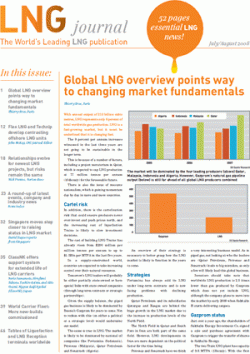
Global LNG overview points way to changing market fundamentals
Written by
Thierry Bros, Paris
With annual output of 213 billion cubic metres, LNG represents only 8 percent of total worldwide gas production. LNG is a fast-growing market, but it must be underlined that it is changing fast.
The 9 percent per annum increases witnessed in the last three years are not going to be sustainable in the longer term.
With annual output of 213 billion cubic metres, LNG represents only 8 percent of total worldwide gas production. LNG is a fast-growing market, but it must be underlined that it is changing fast.
The 9 percent per annum increases witnessed in the last three years are not going to be sustainable in the longer term.
Published in
July / August 2008
A round-up of the latest news and company developments
Published in
July / August 2008
John McKay, LNG Journal Editor
Floating LNG production units being developed by oil majors, LNG engineering firms and major shipyards will seek production capabilities from 1 million tonnes per annum up to the scale of the largest land-based LNG Trains.
Projects under development will significantly boost LNG production from 2015 onwards once the initial facilities successfully enter operations.
Floating LNG production units being developed by oil majors, LNG engineering firms and major shipyards will seek production capabilities from 1 million tonnes per annum up to the scale of the largest land-based LNG Trains.
Projects under development will significantly boost LNG production from 2015 onwards once the initial facilities successfully enter operations.
Published in
July / August 2008
Tuesday, 22 July 2008 06:12
ClassNK offers support system for extended life of LNG carriers
Written byNorio Yamamoto, Hirofumi Takano, Toshiro Koiwa, and Akio Usami, Nippon Kaiji Kyokai (ClassNK).
Japan LNG carriers are now entering a new era of longer operational service lives.
While consideration is being given to designs and plans for the construction of new ships with design lives significantly longer than those of conventional ships, the industry also is seeking to keep the currently well-maintained existing fleet in extended service.
Published in
July / August 2008



