





LEAD STORY
Thursday, 13 March 2008 12:40
Yemen LNG will provide Mideast production for US, South Korea
Written by
LNG journal Middle East Editor
The Yemen LNG project may have a final bill of $300 million more than expected at over $4 billion, but the project will provide much-needed new LNG offtake for the US and South Korea.
Project costs have spiraled on all projects worldwide due to rising prices for labour and materials such as steel as the industry strains to meet rising energy demand.
The Yemen LNG project may have a final bill of $300 million more than expected at over $4 billion, but the project will provide much-needed new LNG offtake for the US and South Korea.
Project costs have spiraled on all projects worldwide due to rising prices for labour and materials such as steel as the industry strains to meet rising energy demand.
Published in
March 2008
Thursday, 13 March 2008 12:39
TGE Marine Gas Engineering puts forward new concept in LNG field
Written by
German-based company evolves two years after Suez spin-off
TGE Marine Gas Engineering is one of the world’s leading engineering contractors for the design and construction of cargo handling systems for ships and offshore units.
The company was founded in 1980. For many years it was a company within the Suez Group, then in May 2006 it was acquired through a management buyout by the current senior management in conjunction with Caledonia Investment of the UK.
TGE Marine Gas Engineering is one of the world’s leading engineering contractors for the design and construction of cargo handling systems for ships and offshore units.
The company was founded in 1980. For many years it was a company within the Suez Group, then in May 2006 it was acquired through a management buyout by the current senior management in conjunction with Caledonia Investment of the UK.
Published in
March 2008
Also in this issue
Thursday, 13 March 2008 12:37
Snecma and partners propose new equipment for LNG energy recovery
Written by
By Noël Marchal of Snecma
Several options exist for cold energy valorization in the LNG regasification process. Using a turbine to produce mechanical power is a very attractive solution, because it can be easily converted to electricity with a generator coupled to the turbine, or directly transferred to the secondary pumps through a mechanical connection.
Several options exist for cold energy valorization in the LNG regasification process. Using a turbine to produce mechanical power is a very attractive solution, because it can be easily converted to electricity with a generator coupled to the turbine, or directly transferred to the secondary pumps through a mechanical connection.
Published in
March 2008
Thursday, 13 March 2008 12:34
Sabine Pass opening advances Chevron LNG infrastructure plan and strategy
Written by
While Cheniere Energy, the LNG facility developer, considers options for its Sabine Pass terminal due to open in Louisiana in a matter of weeks, Chevron Corp. is looking forward to being one of the beneficiaries of what is expected to become the largest US LNG import terminal.
Sabine Pass, designed with an initial peak send-out capacity of 4.3 billion cubic feet per day of regasified LNG, has capacity contracts of 20 years with Chevron and France’s Total.
Sabine Pass, designed with an initial peak send-out capacity of 4.3 billion cubic feet per day of regasified LNG, has capacity contracts of 20 years with Chevron and France’s Total.
Published in
March 2008
A round up of the latest company news and events
Published in
March 2008
Thursday, 13 March 2008 12:25
Equipment choices help create economies at the Mizushima LNG import terminal
Written by
Kenichi Tadano, Yoshifumi Numata and Daisuke Wada, Chiyoda Corp., Yokohama, Japan
Chiyoda Corp. constructed the Mizushima LNG receiving terminal and Japan’s 27th such facility received its first cargo two years ago from Australia. The facility is jointly owned by the Chugoku Electric Power Co., Inc. and Nippon Oil Corp.
Located in at the Mizushima refinery of Nippon Petroleum Refining Co., in Kurashiki City, Western Japan, it currently has one 160,000 cubic metres capacity LNG storage tank.
Chiyoda Corp. constructed the Mizushima LNG receiving terminal and Japan’s 27th such facility received its first cargo two years ago from Australia. The facility is jointly owned by the Chugoku Electric Power Co., Inc. and Nippon Oil Corp.
Located in at the Mizushima refinery of Nippon Petroleum Refining Co., in Kurashiki City, Western Japan, it currently has one 160,000 cubic metres capacity LNG storage tank.
Published in
March 2008
Thursday, 13 March 2008 12:22
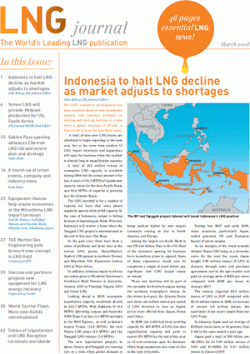
Indonesia to halt LNG decline as market adjusts to shortages
Written by
John McKay, LNG journal Editor
The LNG industry’s development has been slowed by delays in new liquefaction projects and technical problems at existing and start-up facilities at a time when a global shortage of off-take is forecast for at least the next three years.
A total of nine new LNG trains are scheduled to begin exporting in the next 12 months, but at the same time another 12 LNG import terminals will open for business when the global market is already long in regasification capacity.
The LNG industry’s development has been slowed by delays in new liquefaction projects and technical problems at existing and start-up facilities at a time when a global shortage of off-take is forecast for at least the next three years.
A total of nine new LNG trains are scheduled to begin exporting in the next 12 months, but at the same time another 12 LNG import terminals will open for business when the global market is already long in regasification capacity.
Published in
March 2008



