





China's 22pct drop in Q1 LNG imports helps to provide relief for Europe's depleted gas storage, which stands at just 34pct capacity. With Russian pipeline supplies terminated, Member States need approximately 290 additional LNG cargoes to meet the EU's 90pct storage mandate by November. At this juncture, Shell announces plans to expand its LNG business by 5pct annually through 2030.
China's liquefied natural gas imports have fallen sharply this year, providing a boon for Europe as it is working to rebuild its depleted gas reserves in the wake of winter.
Notably, we have observed a divergence of European and Chinese LNG demand since October last year.
According to our data, Chinese LNG imports dropped by almost 22pct to 15.77mmt in Q1 2025, down from 20.11mmt in Q1 2024.
The country’s steep LNG demand reduction stems from multiple factors, including warmer weather reducing heating needs in northern China, weaker industrial demand, increased domestic gas production as well as higher pipeline gas imports, according to Reuters Energy Columnist Ron Bousso.
Whilst we highlight that the month of March has not yet concluded, our preliminary data shows that the bulk of Chines LNG imports were derived from Qatar, Australia and Malaysia.
The three LNG origins together are likely to account for a total of 11.97mmt in LNG flows to China by the end of Q1 this year. The other large-scale LNG producer – the United States – meanwhile has only supplied 0.33mmt between January and February, with no US LNG cargo having made Chinese landfall in March at the time of writing.
Europe's Critical Situation
This reduction in Chinese buying comes at a critical time for Europe.
With near-depleted winter gas storage and the expiry of the last Russian gas pipeline contract in January, European storage levels shown by GIE stood at just 34pct at the time of writing—far below last year's 60pct. With Ukraine likely evolving as another substantial regional LNG buyer in the absence of meaningful alternative pipeline gas supply, we estimate the region could require up to 290 LNG cargoes (depending on vessel size and load levels) compared to last year to meet storage targets.
The European Union’s Gas Storage Regulation mandates minimum gas storage levels of 90pct for Member States by 1 November.
Market Shift
European gas prices surged earlier this year, creating profitable arbitrage opportunities.
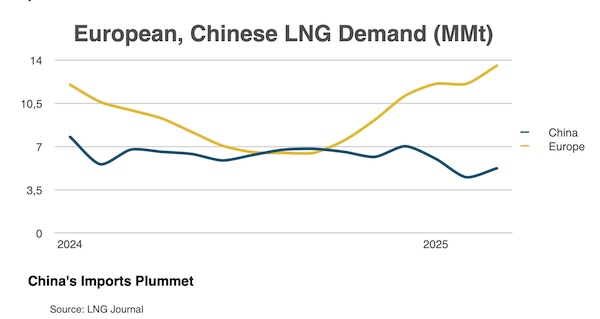
Numerous Asia– and South America-bound cargoes have been diverted to Europe by portfolio players such as Cheniere, PetroChina Trading and Shell, with Europe’s March imports potentially reaching a record-high 13.56mmt, our data shows. US LNG cargoes are typically FOB and thus not destination-bound.
Seeking Growth
Amid these market shifts, energy giant Shell has announced plans to strengthen its position in the global LNG market. During its Capital Markets Day 2025, the company revealed it aims to increase LNG sales by up to 5pct annually through 2030.
CEO Wael Sawan stated that Shell intends to "become the world's leading integrated gas and LNG business," reflecting the company's assessment that LNG will remain a critical transition fuel as the world moves toward cleaner energy sources.
Fortunately for European consumers, significant new LNG capacity will come online this year and beyond, primarily from Qatar and the United States.
This added liquidity may help reduce price volatility while providing Europe the breathing room it needs to address immediate gas storage challenges before next winter.




