





Novatek has suspended operations at its Arctic LNG 2 project due to Western sanctions limiting cargo transport and sales. The halt, reportedly effective since 11 October, reflects difficulties in securing ice-class vessels and finding buyers. The setback threatens Russia's ambition to capture 20pct of global LNG market share by 2030.
Russia's Novatek has recently halted operations at its Arctic LNG 2 project as Western sanctions restrict its options to ship and sell cargoes, according to reports by Reuters and Bloomberg.
The Russian LNG specialist reportedly has no plans to recommence operations this winter, marking a significant setback for Russia’s gas ambitions.
The project, situated on the Gydan Peninsula in the Arctic and majority-owned by Novatek, was meant to expand Russia's share in the global LNG market to 20pct by 2030.
Export Challenges
According to the reports, commercial liquefaction at the facility was halted on 11 October owing to high inventories the plant cannot freely export.
The suspension reflects the mounting difficulties Arctic LNG 2 faces in finding buyers and securing specialised ice-class vessels required for winter operations.
The restrictions imposed by Western sanctions following Russia’s invasion of Ukraine have limited the project's access to South Korea-built ice-class tankers and made foreign buyers reluctant to purchase the affected cargoes.
According to our data, no Arctic LNG 2 cargo had been delivered to facilities outside Russia.
At the time of writing, all cargoes were either still at sea or had been parked on one of Novatek’s giant FSUs in the Murmansk and Kamchatka regions.
Production Impact
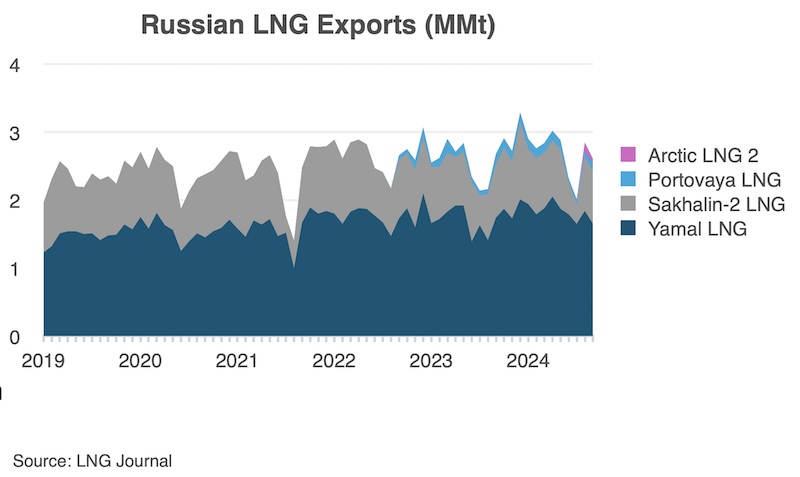
As such, output from Arctic LNG 2 has only had a minor impact on Russia’s LNG exports, which stood at 24.19mmt for the year to end-September.
Exports were thus still up 1.25mmt (5pct) from the 22.94mmt for the equivalent period last year. It was also up 0.42mmt (2pct) from the 23.77mmt we noted in 2022, Russia’s best LNG export year we have on record with total shipments of 32.18mmt.
But the necessary export boost towards the 2030 target now looks unlikely to be forthcoming in the foreseeable future.
The country’s LNG trade remains underpinned by Yamal LNG.
Although output from Sakhalin-2 LNG has picked up again recently following seasonal maintenance, the Far Eastern plant’s exports have been sliding since 2022 and even struggle to match the output seen in the preceding three years.
Shell’s exit from the project likely contributed to the year-on-year decreases.
Concurrently, Gazprom’s Portovaya LNG is too small to compensate for significant production changes by either of the two big plants although it has settled into steady(ish) shipments.
In contrast, Novatek’s Arctic LNG 2 plant had shipped only 0.19mmt by the end of September, according to our data, with total exports before its suspension at roughly 0.32mmt.
This is set to only further isolate Yamal LNG as the main carrier of Russia’s LNG economy.
Adverse conditions
Geoffrey Pyatt, assistant secretary for energy resources at the US State Department, stated that the White House would continue to 'tighten the screws' on Russian LNG to reduce export revenues the Kremlin might use to fund the war in Ukraine.
Apart from sanctions, Russia’s LNG trade with Asia is also made more difficult by the onset of winter.
Arctic LNG 2 managed to begin LNG shipments in August only by deploying conventional gas carriers, often with obscure ownership and vessel tracks.
From mid-October, the Russian government prohibited conventional vessels from journeys across its eastern Arctic waters towards Asia due to harsher than expected ice conditions.
Pack ice can cut into or crush conventional vessel hulls under its mass. Previously, even dedicated Arc-7 ice class carriers have struggled.
This restriction has further limited shipment options for Arctic LNG 2 at least until the sea passage reopens for non-ice-class ships next summer.
The facility has an annual design capacity of 19.8 million tonnes, yet thus far only one train, capable of producing 6.60mmt per year, has been operating.




