





Deutsche Regas GmbH, the operator of the floating liquefied natural gas import terminal at the Baltic Sea port of Lubmin, is now making more progress on meeting operational standards at the company’s second German Baltic regasification terminal, located at the port of Mukran on Germany’s largest island of Rügen.
The floating storage and regasification unit (FSRU) “Energos Power” docked at Mukran on the tourist island of Rügen on February 24.
The second German Baltic Sea received the emission control and water law permits on April 10 for the operation of the terminal under the jurisdiction of the state of Mecklenburg-Vorpommern.
Targets “We have now been able to install all of the currently planned expansion stages for further noise-reducing measures on the ‘FSRU Energos Power’ vessel,” explained Deutsche Regas. “They make a noticeable contribution to further reducing noise emissions from the FSRU,” stated Deutsche Regas.
The company noted that an independent assessor's office continues to measure and ongoing noise emissions in the area of the Mukran industrial port. “These measurements are determining the comprehensive effectiveness of the noise reduction,” added Deutsche Regas. “They also confirm that all legal limit values were adhered to at all times and throughout the entire trial operation,” the company said. “By installing the noise-reducing measures, we would like to keep possible exposure for all residents, for all our neighbours and our neighbours in the area of the Mukran industrial port as low as possible,” stated Deutsche Regas.
Regas vessel The “Energos Power” is 300 metres in length and is part of a plan to provide adequate natural gas to replace pipeline gas previously received from Russia’s Gazprom.
The FSRU “Energos Power” with 174,000 cubic metres capacity had formerly been called the “Transgas Power”.
The Mukran floating LNG operations include a 50 kilometres (31 miles) pipeline that will transport the regasified LNG to the mainland and into the German gas grid.
Deutsche ReGas has cooperated on the project with German Transmission System Operator, Gascade GmbH. Gascade has been overseeing connections to gas grids in the rest of Germany and the European Union via the North European Natural Gas Pipeline (NEL), the Ostsee-Pipeline- Anbindungsleitung (OPAL) and the European Gas Pipeline Link (EUGAL).
The energy terminal will feed up to 13.5 billion cubic metres of gas annually into the EUGAL/OPAL and NEL gas pipeline network, the most important gas supply lines in eastern Germany.
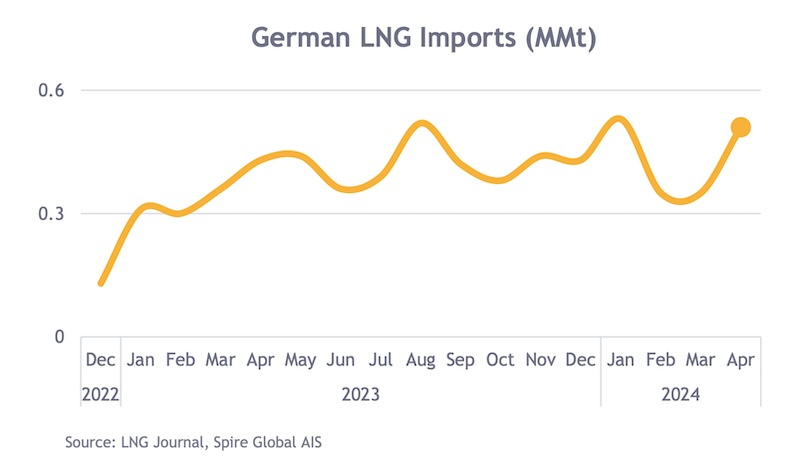
Import growth German LNG imports have had strong growth since a shift in policy in 2022 advocated for a ‘new German pace’ in building domestic LNG import capacity. Imports in April stood at 0.51mmt, up 0.08mmt (19pct) from the 0.43mmt we recorded for April 2023




