





TotalEnergies on course for 4% increase in oil and gas production
Last week, French energy giant, TotalEnergies flagged up its forecast ahead of its third quarter results announcement.
Wärtsilä’s lifecycle agreement renewed for seven LNGCs
Finnish technology group, Wärtsilä and TMS Cardiff Gas have renewed their existing lifecycle agreement, covering the 2-stroke main engines on board seven LNGCs, for a further five years.
Russia’s USC unveils Ice Class LNGC design
Russia’s United Shipbuilding Corp (USC) unveiled an Arc4 Ice Class ‘Sinergiya’ design LNGC at the St Petersburg International Gas Forum 2025, the corporation’s press service said, reported Russian newswire TASS.
GTSI buys GasLog LNGC
Indonesia’s PT GTS Internasional (GTSI) has purchased the GasLog Partners owned LNGC ‘Methane Jane Elizabeth’ for $24.5 mill.
She will be renamed ‘Danaputri 1’.
Built in 2006, the steam powered vessel has a tank capacity of 145,000 cu m.
GTSI said that the acquisition was financed using the remaining proceeds from its initial public offering (IPO) amounting to IDR123.83 bill and internal funds of IDR282.26 bill.
According to the company, the transaction will not have an adverse impact on its financial performance, as it has been carefully planned and supported by allocated IPO funds.
The move is also part of the company’s business development strategy in the shipping and energy sectors, GTSI said in an Indonesian stock exchange filing.
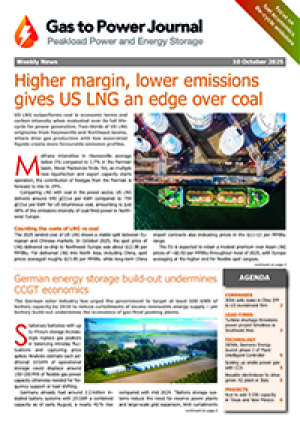
Gas to Power – October 10, 2025
Click to Download
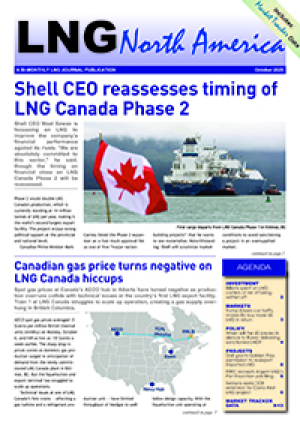
LNG North America – October 2025
Click to Download
Shell CEO reassesses timing of LNG Canada Phase 2
Shell CEO Wael Sawan is focussing on LNG to improve the company’s financial performance against its rivals. "We are absolutely committed to this sector," he said, though the timing on financial close on LNG Canada Phase 2 will be reassessed.
Canadian gas price turns negative on LNG Canada hiccups
Spot gas prices at Canada’s AECO hub in Alberta have turned negative as production overruns collide with technical issues at the country’s first LNG export facility. Train 1 at LNG Canada struggles to scale up operation, creating a gas supply overhang in British Columbia.
Billions spent on LNG carriers at risk of being written off
Up to $48 billion invested in LNG carriers could be at risk of becoming stranded assets by 2035 in a 1.5°C climate scenario, as fleet overcapacity collides with falling demand for fossil fuels. Research at UCL Energy Center, however, clashes sharply with the industry’s rapid fleet expansion.
Trump lowers car tariffs, makes EU buy more US LNG in return
The Trump administration has started to implement a landmark trade deal by lowering auto tariffs to 15 percent – now the onus is on the EU to purchase $750 billion in US LNG, oil, and nuclear energy products by 2028. More US shipments will help bring forward the EU’s ban on Russian LNG to January 2027.



