


Air Liquide claims cryogenic system success
Last year, engineering company, Air Liquide achieved a new milestone with its Turbo-Brayton cryogenic equipment.
Nearly 70 units were ordered during the year.
This solution effectively addresses the challenges of on board boil-off gas (BOG) reliquefaction, the company claimed.
Air Liquide’s technology was first used in the space industry to cryogenically preserve biological samples on the International Space Station (ISS), before being scaled up and adapted for the maritime industry.
Its key features include a 'plug&play' solution, preventive maintenance-free with low electrical consumption and high reliability.
During shipments, LNG tends to reheat and partly evaporate. The Turbo-Brayton sub-cooler cryogenic equipment reliquefies the evaporated natural gas and keeps it in storage in liquid form.
It is specifically designed to be installed on LNGCs and bunker vessels, both on newbuildings and retrofits.
Over the last six years, orders for the system have amounted to more than €1 bill with more than 250 units sold.
LNGC retrofit/conversion market to increase
South Korea’s HD Hyundai Marine Solutions, a shiprepair and maintenance service unit of HD Hyundai Heavy Industries, has benefited from the growing LNGC repair, maintenance and retrofit projects.
LNG China – February 2025
Click to Download
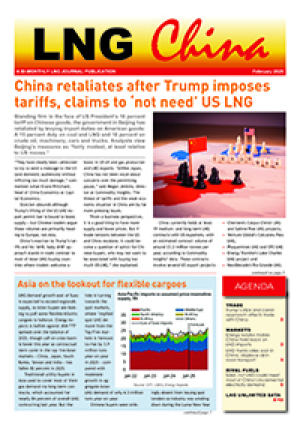
China retaliates after Trump imposes tariffs, claims to ‘not need’ US LNG
Standing firm in the face of US President’s 10 percent tariff on Chinese goods, the government in Beijing has retaliated by levying import duties on American goods: A 15 percent duty on coal and LNG and 10 percent on crude oil, machinery, cars and trucks. Analysts view Beijing’s measures as “fairly modest, at least relative to US moves.”
Asia on the lookout for flexible cargoes
LNG demand growth east of Suez is expected to exceed regionals supply, so Asian buyers are looking to pull some flexible Atlantic cargoes to balance. Energy Aspects is bullish against JKM-TTF spreads over the balance of 2025, though call on cross-basin is lower this year as contractual term cover in the top five Asian markets – China, Japan, South Korea, Taiwan and India – has fallen 82 percent in 2025.
Trump’s stick and carrot approach affects trade with China
Expanded US LNG production and exports could be used as a bargaining chip by the Trump administration in trade negotiations with Europe, Russia and other major economies in Asia. “Europe is still searching for reliable, long-term alternatives to Russian piped gas and LNG supply, while China-US LNG trade is likely to be affected by tariffs,” commented Rystad Energy’s head of North America Gas & LNG Research, Emily McClain.
European leaders have already hinted at using US LNG purchases as a bargaining tool to avoid potential trade tariffs under Trump’s administration. “By aligning energy policies and prioritizing US imports, Europe could secure a stable energy supply while fostering stronger transatlantic relations,” analysts at the Oslo-based consultancy suggested.
Trade tariffs 2.0 risk to push up energy prices
Trump has a legacy of levying trade tariff during his first administration which has been a great cause of concern about policy risks on the future cost of LNG and global trade. A 25 percent steel tariff, for instance – as implemented in 2018 – led to significant price increases for LNG projects. And this trend that could repeat under Trump 2.0.
Another trade war with China, meanwhile, could disrupt the flow of LNG between the two countries, just as it did in 2019 when LNG exports were halted. “Such tariffs would not only elevate capital expenses for LNG projects,” McClain warned, “[they would] also risk slowing contracting activity with key buyers like China, jeopardizing long-term export growth.”
On the other hand, there is a risk of oversupply on global LNG markets especially if multiple new US LNG projects move forward simultaneously. An oversaturated market could erode prices, disadvantaging US producers compared to competitors like Qatar and Australia. Reliable US supply, on the other hand, would also unlock new demand, particularly from price-sensitive markets in Asia – if executed strategically.
Energy surplus makes China hold back on LNG imports
Cracks loom large in the bullish picture for LNG demand in China as utility buyers turn away from ordering high-priced cargoes. Demand for spot LNG cargoes stayed moderate – even during 2024 summer heatwaves – as hydropower exports from Yunnan into Guangdong province can reached up to 1 TWh per day.
LNG trucks sales soar in China, displace oil in road transport
China’s rapid adoption and scale-up of LNG trucks sales is displacing the use of oil and oil products in road transport, lowering diesel demand. Based on the current order book and stringent environmental regulations, the International Energy Agency (IEA) expects the number of LNG-fuelled ships to almost double and reach over 1,200 vessels by 2028.
Solar, not LNG could meet most of China’s incremental electricity demand
Fast build-out of renewable energy sources (RES) in China could meet the country’s entire new electricity demand this year, paving the way for the country’s power sector to achieve peak emissions in 2025 – as the actual installed RES capacity will most likely exceed the government’s target. LNG, in contrast, is too expensive on a cost basis to displace coal.
In industrialised provinces in eastern China, where the energy demand is high, the deployment of distributed photovoltaic projects could accelerate as utilities seek to reduce their reliance on thermal coal. In fact, it is renewables – not LNG – that displaces coal for power generation in China and much of Asia.
Domestic coal outcompetes LNG on cost
Comparing the costs, the price of imported LNG to China is too high to materially displace coal. According to Chinese customs data, the average cost of imported LNG is nearly three times that of domestically produced coal and gas. It is also between 37 and 61 percent more expensive than pipeline gas imports from Russia and other Asian countries.
Coal generation is typically US$30-40 per MWh cheaper than gas-fired power generation, analysis by by the Institute of Energy Economics and Financial Analysis (IEEFA) shows. Onshore wind and utility-scale solar are found to be “the cheapest power sources,” costing roughly half as much as gas-fired power generation.
Though LNG prices are set to fall in the coming years as more US liquefaction capacity comes to the market, IEEFA analysts anticipate “prices are unlikely to drop to levels that are competitive with coal or renewables.”
Wind power displaces thermal coal
In fact, China’s growing LNG imports have not reduced or slowed the expansion of its coal consumption. Since 2017, coal demand has increased more than LNG imports every year. In the electric power sector, which accounts for 60 percent of China’s total coal usage, the share of gas-fired power generation has remained at just 3 percent since 2015, while the share of wind and solar generation has quadrupled to 16%. Although coal-fired generation has increased during this time, its relative market share in the power mix has fallen from 70 to 61 percent.
“While coal has not been displaced in absolute terms, wind and solar have contributed more than gas to reducing coal’s share in the generation mix,” said Christopher Doleman, IEEFA’s specialist for LNG and natural gas. “Looking ahead, annual capacity additions of coal, wind, and solar will continue to exceed new gas-fired power capacity.”
Policies control coal-to-gas switching
Government policies in China strongly favour the use of domestic energy sources – notably coal, energy from wind and solar as well as hydropower, and indigenous natural gas.
Recent policies aim to “strictly control” coal-to-gas switching and position coal, rather than gas, as the cornerstone of electrical reliability. For instance, there are plans to retrofit 200 MW of existing coal-fired capacity to balance the integration of intermittent solar and wind generation. On the other hand, the government’s gas strategy aims to make sure that imports of both pipeline gas and LNG do not rise above 50 percent of total consumption.
China’s rapid AI rollout clashes with plans to exit fossil fuels
Rapid development of Artificial Intelligence (AI) in China makes it imperative for the government to reassess the timeframe of phasing out fossil fuels. Growth of clean energy production alone is unable to meet AI's rising energy needs – fossil fuelled power will have to fill the gap, says Lin Boqiang, director, China Center for Energy Economics Research.