





A host of new measures are aiming to reduce the shipping industry’s impact on the environment. The required cuts in emissions to air have the experts pointing to LNG as the best solution for vessels to comply.
Let us consider the factors influencing any decision to invest in LNG-fuelled vessels and the challenges facing the development of LNG infrastructure.
For a shipowner considering the installation of an LNG system on a vessel, the first question is the price difference between LNG and heavy fuel oil.
Price levels
Provided that the price levels are more or less equal, it certainly makes commercial sense to opt for LNG.
And the more time a ship spends inside of Emission Control Areas (ECAs), the faster the additional investment will pay off.
The equation as such is quite simple, but market prices are not as transparent as they could be. So the crucial question is: Can we identify reliable figures to base our decision on?
In the case of heavy fuel oil, the figures are relatively transparent. What leads to uncertainty is the LNG market.
The absence of a global market for LNG makes it extremely difficult today to predict what the cost of LNG will be five years from now.
This is further complicated by the marked difference in LNG prices between the US, Europe and Asia, which is much larger than that in heavy fuel oil prices. In the US, LNG currently costs a fraction of what ship operators would have to pay in Asia.
 |
|
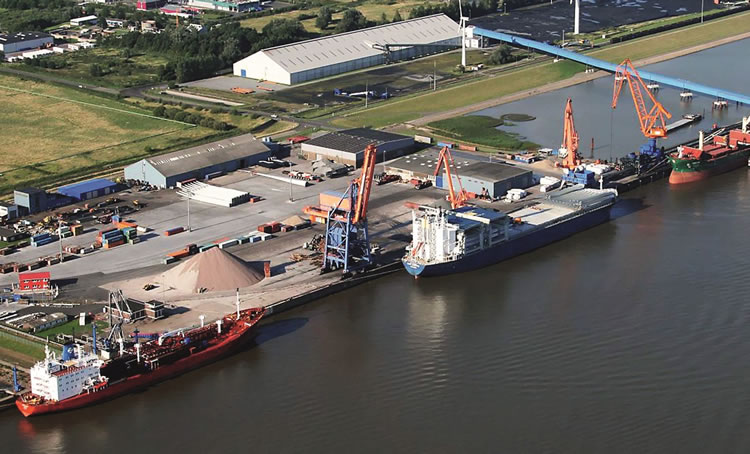
Brunsbüttel Port (above) in Germany and Gasnor of Norway signed an agreement that will enable vessels to bunker LNG in the port. This landmark contract is essential for making LNG available to ships at the junction of the River Elbe and the Kiel Canal. The short-distance shipping sector is at the forefront of LNG fuel adoption |
Prediction
However, we can predict with some certainty that LNG will be, and remain for the foreseeable future, more economical than marine gas oil (MGO), and this difference will drive the return on investment in vessels operating in ECAs.
However, the decision to adopt LNG rests primarily on the price difference between LNG and heavy fuel oil.
And there are indications that ship operators may receive LNG at the price of heavy fuel oil in Europe today if they negotiate well.
Owners must look at the costs of investment accurately to assess whether a decision to implement LNG on a vessel makes sense.
GL has recently completed a new joint study with ship power systems maker, MAN of Germany, analysing the costs and benefits of LNG-powered container vessels.
Investment
The results suggest an additional initial investment in the order of $300 to $500 per kilowatt, taking all the LNG-related equipment into account.
We also investigated the payback times for various configurations, ship sizes, routes, ECA exposures and fuel prices, and conducted extensive research to identify the dominant parameters for this calculation.
The study shows that the price difference between heavy fuel oil and LNG and the amount of time a vessel operates in ECA zones are the most significant factors in determining the payback time for the investment in LNG before 2020.
The establishment of more ECAs could then also act as a spur to LNG adoption.
We know, for example, that deep-sea vessels typically spend five to six per cent of their operating time in ECAs.
But this figure could grow considerably on a number of shipping routes once the new requirements for ship-fuel quality, which are equivalent to those in northern Europe, take effect along the North American coastlines in August 2012.
New curbs
In addition, a number of other sea areas are expected to introduce similar restrictions on emissions before 2020, the effective date of the global sulphur limits on heavy fuel oil.
Again, it makes sense to look more closely at LNG for vessels operating more in ECAs.
There are many other factors for owners to consider.
One particular concern we considered in the joint MAN-GL study was investment costs and their dependence on the availability of refuelling stations.
For example, a vessel operating on a typical deep-sea route between Asia and Europe would require a tank capable of holding enough fuel for one half of the ship’s round trip.
On a very large vessel this would be in the region of 10,000 cubic metres. However, a ship that can carry only enough fuel for half of its round trip would be more exposed to fluctuating fuel costs at its destinations.
Tanks
On the other hand, limiting the tank size will directly affect the construction cost as LNG tanks are very expensive.
It also means that less cargo space will be taken up by the tank, which increases the income potential of the vessel.
As more LNG fuelling stations are constructed in ports, the acceptance of this technology will benefit accordingly.
There is increasing pressure on ports and ship operators to improve the turnaround time for bunkering and this will have an impact on LNG-fuelled vessels.
We are just beginning to delve into the question how much time it actually takes to bunker LNG safely.
What we do know is that our customers will expect a similarly convenient bunkering process for LNG as for heavy fuel oil, including an acceptable time frame.
Bunkering
Today the process of preparing for LNG bunkering involves cooling down and inerting the systems and potentially the tank itself before beginning the actual refuelling process.
But there are efforts underway to reduce the required preparation time. For example, it is possible to begin cooling down the hoses before making the actual connection.
Similarly, the ship’s crew could start cooling down the board-side system before connecting. There are a number of options we have not fully explored.
As commercial interest builds we will see the rapid development of new technology to facilitate LNG bunkering that is not established today.
This is a technical challenge that can be overcome, and it is certainly one of the reasons why short-sea shipping is at the forefront of LNG adoption. You might say, it serves as an experimental laboratory for deep-sea vessels.
Locations
Access to LNG bunkering is also developing. A number of ports offer LNG facilities, particularly in northern Europe. In the spring of 2011, a new LNG terminal was commissioned by Linde at Nynäshamn, south of Stockholm, which will offer LNG ship refuelling very soon.
Recently Gasnor announced they will make LNG available in the German port of Brunsbüttel. The company plans to supply the liquefied gas by truck initially, and possibly build a small terminal in the future provided that demand develops accordingly.
Such announcements from the supply industry are very helpful in encouraging shipowners to consider using LNG.
It is important to demonstrate to owners that the supply side is willing to make a start and build up the required infrastructure as demand grows.
GL is currently working with the Hamburg Port Authority (HPA) to explore possible options for offering LNG ship fuel in Hamburg.
EU-funded
In addition, GL is participating in an EU-funded project called “Clean North Sea Shipping” and is taking other initiatives.
Several of our present R&D projects examine the practical and safety aspects of potential LNG bunkering facilities in Hamburg and other ports, with a focus on technical feasibility.
Of course, shipowners need supply options and suppliers need vessels to supply.
GL has taken such a strong stance in support of this technology. We believe we can be a driving force in this area, and we have become involved in a number of activities, such as research, the development of rules and design concepts, and some initial commercial applications.
Without substantial expert support from classification societies such as GL, technologies such as LNG will not be developed, at least not at the speed we are presently seeing.
Satisfied
It is very satisfying for us to contribute to this development, to truly inspire people to use the available technology and to engage with us to implement it. I certainly hope the industry will eventually look back and say that moving in this direction was the right decision.
As regards regulatory issues. Even before the strict ECA emissions requirements were adopted at the IMO, a process of regulatory development addressing the use of gases as ship fuel had already started, based on a proposal tabled by Norway in 2004.
This delivered the so-called IMO Interim Guidelines on Safety for Natural Gas-Fuelled Engine Installations in Ships (Resolution MSC.285(86)). These guidelines contain the very latest safety concepts for using gas as a ship fuel.
They address, inter alia, ship arrangement and design, fire safety, electrical systems, control and safety systems, engines, building and operational procedures.
They are implemented by flag states on a voluntary basis, so it can safely be assumed that a flag state will accept a proposed ship design.
GL issued its own guidelines, incorporating the IMO Interim Guidelines and adding its own interpretations.
Guidelines
The GL guidelines help shipowners and yards prepare for the introduction of gas as a ship fuel. The new guidelines provide criteria for the design arrangements and installation of propulsion and auxiliary machinery powered by natural gas to ensure a level of integrity, safety, reliability and dependability equivalent to that of comparable, state-of-the-art machinery burning conventional fuel oil.
At present, the IMO Sub-Committee on Bulk and Liquid Gases (BLG) is working on the International Code of Safety for Gas-Fuelled Ships (IGF Code), which will supersede the Interim Guidelines and is planned to enter into force at the same time as the 2014 revision of SOLAS.
As such, the IGF Code will be published in time for ships using LNG as ship fuel to meet the strict ECA emissions requirements.
However, there are many outstanding technical issues which still need to be resolved by BLG before an agreed draft IGF Code can be delivered to the IMO’s Maritime Safety Committee (MSC) in spring 2013 as scheduled.
Outstanding items include the necessary distance between an LNG tank and the outer hull of the ship, which is relevant in cases of collision, and the question of whether the LNG tank may be placed below the accommodation, which is in particular relevant for passenger ships.
Conversion
The GL classed “Bit Viking” is the world’s first vessel in service whose main machinery has been converted to burn LNG as fuel.
She is also the largest commercial vessel which is not an LNG tanker, to use LNG as fuel. The conversion, which was overseen by GL, saw the main engines replaced and two large LNG tanks installed on deck, each with a capacity of 500 cubic metres, giving the vessel a range under LNG of 12 days.
Conversions of existing vessels to use LNG as ship fuel, however, are assumed to be limited due to a lack of engine type retrofit options and available space for LNG tanks.
The first vessels to use LNG as ship fuel were large LNG tankers using boil-off gas as fuel. Later generations of LNG tankers also used traditional ship fuels such as HFO.
The first vessels built to use LNG as fuel, and to thus benefit from lower emissions levels, were a ferry (in 2000) and two offshore service vessels (in 2003) operating in Norwegian waters.
Norway fleet
To date, another 13 such vessels have been commissioned, making Norway the country with the largest fleet of LNG-fuelled vessels. At the same time, an LNG supply infrastructure has been established along the Norwegian coast.
There are a growing number of vessels on order which are designed to use LNG as ship fuel. Recent additions to the order books include: a ferry ordered by Viking Line for operation between Finland and Sweden, and a general cargo ship has recently been ordered by Norline for operation in the North Sea.
Additionally, a number of offshore service vessels are on order, two of which are intended for an operation in US waters off the Gulf of Mexico.
LNG has yet to make a commercial impact on the box ship market, but it seems only a matter of time before a shipowner takes this next step, with approvals in principle given to a number of designs in recent years.
The first study on an LNG-fuelled container feeder vessel was published by GL in early 2009 and demonstrated the concept’s technical feasibility and commercial attractiveness for operations within an ECA, as compared with a standard vessel of today.
In addition, GL has recently issued approval in principle (AIP) certificates, on the basis of the GL guidelines, for several container vessels designed to use LNG as ship fuel and with capacities between 3,000 and 14,000 TEU.
Pierre Sames, Senior Vice President, Strategic Research and Development, Germanischer Lloyd AG, Hamburg, Germany
/tablebr //span



