





ANADARKO Petroleum Corp., developer of an LNG project from feed-gas discoveries offshore Mozambique, expanded its recoverable reserve estimates to 15 to 30-plus trillion cubic feet, making feasible the US company's vision of six liquefaction Trains. Anadarko's offshore partners in the discoveries include companies from Japan and India. The company said its Barquentine-3 appraisal well encountered more than 662 net feet (202 metres) of natural gas pay in two high-quality Oligocene-aged fan systems, significantly expanding the estimated recoverable resource range, said the company. "The positive results of each appraisal well that we have drilled and analyzed have continued to increase our estimate of recoverable resources and natural gas in place on our block, and to add to our confidence that this could be one of the most important natural gas fields discovered in the last 10 years, with significant long-term benefits for Mozambique," said Anadarko Chairman and Chief Executive Jim Hackett. "In parallel, we've continued to advance an expandable LNG development that will support this world-class field. This is great news for Mozambique, as our ongoing activities will continue to spur meaningful investment in the region, generate significant revenue for the government and offer a multitude of opportunities for the people of Mozambique,” Hackett stated. Anadarko President and Chief Operating Officer, Al Walker, explained that the results of Barquentine-3 indicated that they were continuing to "encounter very thick sands with high-quality rock throughout these massive, connected reservoirs.” Walker stated: “Recoverable resources of this size and quality are perfectly suited for a large-scale LNG development, which is currently being designed to consist of at least two Trains with the flexibility to expand to six Trains. We also plan to leverage our experience with Independence Hub by constructing an offshore hub facility that will be tied back to the LNG plant onshore. We are already nearing the completion of the pre-FEED (front-end engineering and design) activity and expect to begin FEED work in the near future.” Simultaneously, Anadarko said it has analyzed two new 3D seismic data sets and was “excited to have the rig commitments in place to continue appraisal work." The company said it was accelerating its exploration activities, including testing a growing number of high-potential prospects in other areas of the Offshore Area 1. Anadarko said it was mobilizing the “Deepwater Millennium" drillship for the Offshore Area 1. The company also recently signed a four-year contract extension that will keep the “Belford Dolphin” drillship working in the basin as part of its ongoing programme. The Barquentine-3 appraisal well was drilled to a total depth of around 13,400 feet (4,084 metres) in water depths of some 5,170ft (1,575m). The well is located 2.75 miles (4.4km) southeast of the Barquentine discovery well and 1.8 miles (2.9km) south of the Barquentine-2 appraisal well. “The partnership will preserve Barquentine-3 for use as a monitor well during its upcoming testing programme. The drillship will next move to top set the Barquentine-4 appraisal well,” the statement added. Anadarko is the operator of the 2.6-million-acre Offshore Area 1 with a 36.5 percent working interest. Co-owners in the area are Mitsui E&P of Japan (20 percent), BPRL Ventures of India (10 percent), Videocon of India (10 percent), Ireland-based Cove Energy (8.5 percent) and Mozambique national energy company (15 percent).
AUSTRALIA Pacific LNG, the coal-seam-gas-to-LNG project being developed in Queensland by ConocoPhillips, said it signed a heads of agreement with Japanese utility Kansai Electric Power Co. or the sale of around 1 million tonnes per annum of LNG for 20 years. APLNG intends to produce 9 MTPA of LNG from feed-gas delivered to its Curtis Island liquefaction plant along a 500-kilometre pipeline from the Surat and Bowen Basins in south-west and central Queensland. Australia's Origin Energy is the ConocoPhillips partner in the project and China's Sinopec also holds a 15 percent stake. APLNG Chairman and Origin's Managing Director, Grant King said: “This binding heads of agreement is another significant milestone for the Australia Pacific LNG project, and we look forward to building a long-term, collaborative relationship with Kansai. The signing of a long-term supply agreement demonstrates further momentum towards a two-Train development, with detailed negotiations continuing with sufficient customers to support a second Train final investment decision. ConocoPhillips' Senior Vice President Exploration and Production, Ryan Lance said: “Kansai Electric is an experienced LNG buyer, and we look forward to supplying LNG to help support Japan's energy requirements. This agreement signifies the strength of a relationship that has been built on mutual respect and trust amongst our companies.” Under the terms of the agreement, the APLNG cargoes will start being delivered to Japan from mid-2016. The deal is also conditional on APLNG making a final investment decision on the second Train, which is targeted for early 2012. The APLNG project was sanctioned in July 2011 for an initial 4.5 MTPA.
AWILCO LNG, the Norwegian-listed carrier company with three vessels in operation and two more on order, posted a jump in revenues because of “high activity” in the LNG spot market. Awilco reported freight income of $12.3 million in the third quarter compared with $1.6 in the second quarter just after it had begun operations with its fleet of three second-hand Japanese LNG carriers. Awilco was listed on Oslo Stock Exchange as of September 6, 2011. One of the highlights of the quarter was the fixing of the “WilGas” on a one-year charter with Brazil's Petrobras. The company said in its statement to the Oslo bourse that its third-quarter vessel utilization was 47 percent compared with 26 percent in the second quarter. During the quarter, both the “WilGas” and the “WilEnergy” loaded their first cargoes. “WilGas” was thereafter fixed on a one-year charter starting mid-October, and “WilEnergy” was subsequently fixed as well. The carrier “WilPower” was redelivered after a five-month charter at the end of October, and is currently trading on the spot market. “The market continued to firm during the third quarter and activity is high,” it added. Awilco has entered into firm newbuilding contracts for two 155,900 cubic metres capacity LNG carriers with Daewoo Shipbuilding and Marine Engineering, with expected delivery in August and November 2013. The construction cost is around $200M per vessel, it said. The financing of the first three instalments will be by equity (selling shares), while the last instalment would be a combination of equity and debt, Awilco said. It also declined to take up an option for two more vessels.
CANADIAN prospects of becoming a key new LNG exporter have been boosted by a new report from regulators forecasting a shale and tight gas boom driving production above record levels, thus providing long-term feed-gas for LNG. The National Energy Board said in its 64-page report out to 2035 that large and rapid growth of shale-gas production was guaranteed and that even net crude oil available for export would more than triple by 2035. The report acknowledges that other forecasts put Canada's future natural gas levels from shale gas and tight gas much higher. “The trend toward targeting tight gas and shale gas brings about some pronounced shifts in Canadian production. By 2014, tight gas production becomes larger than all other conventional production in Canada and stays larger over the projection period, accounting for 49 per cent of total Canadian production in 2035,” the report said. “The proportion of shale gas also grows, making up 22 per cent of production in 2035. The growth of the Montney tight gas play and Horn River shale play increases production in northeast British Columbia, surpassing Alberta production by 2019 and remaining higher,” the NEB stated. Marketable Canadian natural gas production in the high case reaches 584.2 million cubic metres per day (20.6 billion cubic feet per day in 2035. Production increases in tight, shale, and Mackenzie gas exceed other conventional gas declines, the report said. Net natural gas available for export (including pipeline) in one scenario could increase by 50 per cent from 2011 to reach 165.5 million cubic metres per day (5.8 billion cubic feet per day) in 2035. However, the level of pipeline exports to the US would depend on the surplus levels over the border. The overall increase in US production has helped to dampen North American natural gas prices since 2009, the report said. The future growth of US shale gas production and its impact on North American gas prices will influence Canadian production, producer revenues and the amount of Canadian gas demanded by the US. If the US begins to export significant volumes of US-produced LNG, oversupply conditions in North America could be reduced, the report said. To gather information for the report, the NEB said it held cross-Canada consultations to seek the views of Canadian energy experts and other interested stakeholders, and then conducted its own extensive quantitative analysis. NEB Chair Gaétan Caron said: “This document is a means for the NEB to fulfil our vision of contributing to the pursuit of a sustainable energy future for Canada.”
CHENIERE Energy sealed its second major sales deal for its LNG liquefaction plant being built on the US Gulf Coast to export surplus US natural gas after Spain's Gas Natural Fenosa joined BG Group of the UK as a foundation customer. Cheniere has now cleared the way to raise financing for the project at the existing Sabine Pass import facility that could take the US on the road to being a leading world exporter of LNG. The two sales and purchase agreements now signed by Cheniere with blue-chip European customers will give traction to other North American LNG export projects being planned for existing facilities on the Gulf coast and the US northeast, and for greenfield export projects being developed on the west coast of Canada. Houston, Texas-based Cheniere said Gas Natural Fenosa (GNF) had agreed to purchase 3.5 million tonnes per annum of LNG. The Sabine plant will have Phase-One liquefaction capacity of 9 MTPA of LNG from two Trains and SPAs signed with GNF and BG amount to 7 MTPA. Under the agreement, GNF will pay Chenier's Sabine Liquefaction operating company a fixed sales charge for the full annual contract quantity and will also pay a contract sales price for LNG purchases based on the Henry Hub index traded on the New York Mercantile Exchange. LNG will be loaded onto GNF's own LNG carriers. The Spanish company has a fleet of 10 vessels. The SPA has a term of 20 years with an extension option of up to 10 years. LNG deliveries are expected to commence in 2016.
CHINA’S fifth LNG import terminal, the Dalian facility owned by PetroChina and located in the north-eastern province of Liaoning, formally began operations with the unloading of its first cargo. PetroChina said the Dalian facility was operating efficiently during the unloading process that will commission the terminal for future deliveries. Dalian will receive LNG cargoes from the world's largest LNG producer Qatar and from the spot market as the natural gas market develops in north-eastern China. With five LNG terminals in operation PetroChina and China National Offshore Oil Corp. will continue to build the nation's infrastructure as nationwide demand grows. China's main LNG import terminals are in the southern areas of Guangdong and Shanghai, where imports principally arrive from Australia. At the same time China is also increasing its pipeline exports from Central Asia. Analysts said that by the end of the decade China could be the benchmark for Asian natural gas pricing as it builds up its imports. In addition to LNG, pipeline imports from Turkmenistan give China an alternative source of natural gas and more competitive price-wise than spot LNG cargoes.
 |
|
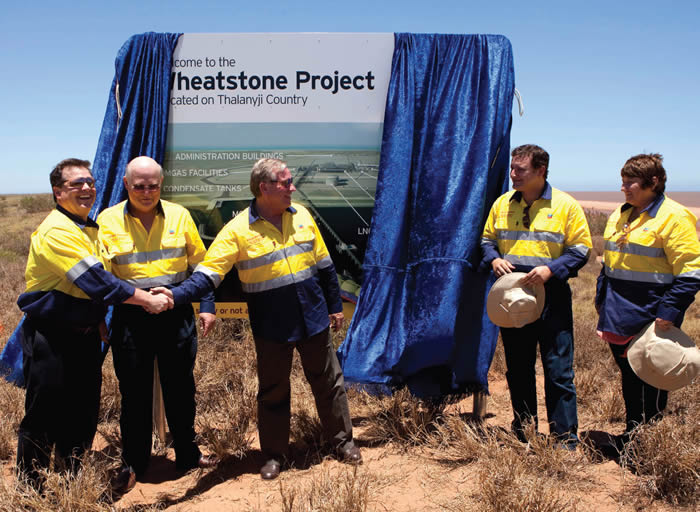
Western Australian Premier Colin Barnett and George Kirkland, Vice Chairman of Chevron, were among those who took part in the Wheatstone LNG ground-breaking ceremony near the plant site at Ashburton |
CHEVRON Corp. and its joint venture participants have commemorated the start of construction of the US$29 billion Wheatstone LNG project with a ground-breaking ceremony at Ashburton North, near Onslow on Western Australia's Pilbara coast. Senior executives from Chevron, Apache Corp. of the US, Kuwait Foreign Petroleum Exploration Company (Kupfec) and Royal Dutch Shell were joined at the site by Western Australian Premier. Colin Barnett. George Kirkland, Vice Chairman, of Chevron, said the event formally marked the start of construction of one of Chevron and Australia's largest resource projects. “We're constructing a facility that will benefit generations. Like Gorgon, it will produce energy by redefining what technically-complex, environmentally-responsible projects look like in the 21st century,” Kirkland said. Melody Meyer, President of Chevron's Asia Pacific Exploration and Production Co., said Wheatstone would provide vital supplies of natural gas to Australia and the region. “Combined with the Gorgon LNG project, this further enhances Chevron's position as a leading supplier of natural gas in the Asia-Pacific,” Meyer said. Roy Krzywosinski, Managing Director of Chevron Australia, added that construction of the project would take about five years with first gas planned for 2016. “Since the Wheatstone project was sanctioned in September, preliminary site works have started. The accommodation complex, which will house more than 4,300 construction workers, will be one of the first facilities to be built at the site,” Krzywosinski said. The Wheatstone onshore foundation project is a joint venture between Chevron (73.6 percent), Apache (13 percent), Kupfec (7 percent), and Shell (6.4 percent). The foundation project comprises two LNG Trains with a combined capacity of 8.9 million tonnes per annum and a domestic gas plant. It is forecast to create more than 6,500 direct and indirect jobs at peak construction and result in more than A$17 billion being spent on Australian goods and services.Western Australian Premier Colin Barnett and George Kirkland, Vice Chairman of Chevron, were among those who took part in the Wheatstone LNG ground-breaking ceremony.
CHEVRON said one of its most senior executives, John D. Gass, was retiring after 37 years during which he helped to turn the US major in one of the world's leading LNG suppliers. Chevron named Joseph C. Geagea as President of its Gas and Midstream division to replace Gass. Commenting on Gass's retirement, John S. Watson, Chevron's Chairman and Chief Executive, said: “John has done a tremendous job in establishing a global gas business that underpins a major part of Chevron's long-term growth. Chevron is poised to grow into one of the world's leading suppliers of LNG, which is a reflection of John's many contributions." His replacement Geagea, 52, is currently the managing director responsible for Chevron's exploration and production activities in the Asia South region. In his new role, Geagea will be responsible for commercializing Chevron's natural gas resources and supporting the development of new growth opportunities worldwide, Chevron said. He will also oversee Chevron's shipping, pipeline, power and natural gas trading operations. Geagea will report to George L. Kirkland, Chevron's Vice Chairman and Executive Vice President of Upstream and Gas. “Joe's enterprise-wide experience and his demonstrated ability to advance our exploration and production interests across east and south Asia, make him well qualified to assume this larger role inside Chevron,” said CEO Watson. Pierre Breber, 47, will succeed Geagea as managing director of the company's Asia South region, reporting to Melody Meyer, President of Chevron Asia Pacific Exploration and Production Co.
EDF Trading said it finalized an agreement to access the Gate LNG import terminal in Rotterdam as it builds up its positions in the Northwest Europe natural gas market. The Gate facility, owned and operated by Dutch companies Gasunie and Vopak, began commercial operations two months ago. The two-year agreement is with one of the primary shippers to the Gate terminal and will allow the EDF Group to take additional deliveries of LNG before its own terminal is commissioned at the Channel port of Dunkirk. “As one of the leading participants in the global LNG market, we are pleased to have access to this new facility as it will enable us to deliver gas to the EDF Group and our third-party customers in The Netherlands,” said Steve Lewis, Global Head of Gas at EDF Trading. EDF Trading has master agreements with the major LNG producers worldwide and recently sold its 150th LNG cargo. Its activities include terminal operations, regasification, downstream marketing, offshore transportation management and hedging services to producers and major consumers of gas.
FLEX LNG, the Norwegian developer of a hull-based Floating LNG liquefaction system, said it was investigating alternative commercial arrangements for three of its “LNG Producers” on order with Samsung Heavy Industries in a bid to attract more project developers. Flex said the alternatives could include integrated projects consisting of gas supply contracts with energy companies, product handling agreements for the services of the “LNG Producers” and LNG sales and purchase contracts with LNG off-takers, as well as more traditional charter arrangements. In April 2011, Flex signed a preliminary agreement to supply one of its LNG production vessels to an LNG project in Papua New Guinea. The project is being developed by InterOil, Pacific LNG and others and has a start-up date of 2014. The project was most recently stalled as the PNG government believes the venture to liquefy feed-gas from the onshore Elk and Antelope gas fields in the Gulf Province in PNG needs a further bigger investor with LNG experience. Meanwhile, Samsung has also agreed restructure its commercial relationship with Flex, allowing all previous instalments paid to Samsung under the existing four shipbuilding contracts to the single FLNG unit that is destined for the PNG project. Flex would remain able to order additional FLNG units from Samsung. The latest information on Flex's activities was contained in its latest earnings report. The company posted a loss of $3.6M in the quarter and $19M for the first nine months, compared with a loss of $8.6M in the same period last year.
 |
|
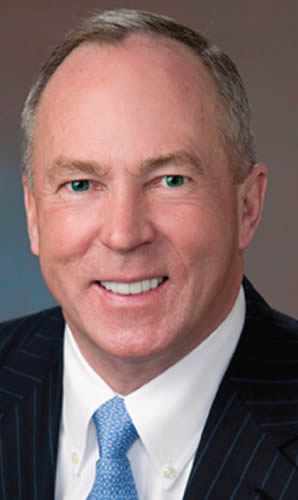
John T. Gremp President and Chief Executive of FMC Technologies. |
FMC Technologies Inc. said its Australian subsidiary has signed an agreement with Chevron Corp. for the design, manufacture and supply of subsea production systems to support the Wheatstone LNG project. The contract was worth around $325M in revenue to FMC, said a statement from the Houston, Texas-based company. The Chevron-operated Wheatstone project comprises the Wheatstone and Iago natural gas fields, located offshore Western Australia in water depths between 330 and 850 feet (100 to 260 metres). FMC's scope of supply includes 11 subsea production trees, 11 wellheads, three manifolds, subsea and topside controls and well access systems. The equipment will be supplied from FMC's Asia-Pacific operations, with deliveries scheduled to commence in 2013. “We are pleased to supply Chevron with the subsea systems for Wheatstone, which will be one of Australia's largest resource projects,” said Tore Halvorsen, FMC's Senior Vice President, Global Subsea Production Systems. “FMC has a strong and established presence in Australia, and the announcement provides excellent opportunities for the Australian industry to participate in this project as primary and secondary suppliers, demonstrating our commitment and maintaining our subsea leadership position in the region,” Halvorsen said.
FMC has signed an alliance deal with Anadarko Petroleum, developer of new natural gas discoveries offshore Mozambique, enabling Anadarko to push forward with plans for a world-class LNG project in the southeast African nation, and with other projects. Anadarko will now have FMC on hand as it pursues its extensive offshore programme, particularly on the recent Mozambique natural gas discoveries, which the US company described as the biggest in 10 years. It has expanded its estimated recoverable resource range to 15 to 30-plus trillion cubic feet of natural gas, with an estimated 30 to 50-plus Tcf of natural gas in place. Anadarko is having engineering studies carried out for an initial two-Train liquefaction project amid the possibility of having enough feed-gas to support six Trains in further expansions. FMC supplied equipment for Anadarko's first subsea project in 1999, North Garnet, in the Gulf of Mexico. Since then, the companies have collaborated on other projects including Independence Hub, the largest natural gas processing facility in the US Gulf, a statement said. FMC has also supplied Anadarko with the industry's first subsea wellhead qualified at a pressure rating of 20,000 psi. “An alliance has been in place with Anadarko and its legacy companies since 1992 to support their Gulf of Mexico exploration and production projects,” said John Gremp, FMC Chairman, President and Chief Executive Officer. “The announcement will allow FMC to broaden its support of Anadarko's expanding exploration and production activities worldwide, including recent discoveries offshore the East and West coasts of Africa,” Gremp added.
GE Oil & Gas signed a contract with Qatargas to upgrade six GE Frame 6B gas turbines providing the power for three LNG liquefaction Trains at the Qatargas I plant near Ras Laffan port. The advanced combustion technology will reduce gas turbine emissions at the Qatargas 1 utility complex to meet new regulations from the Qatari Ministry of Environment. The deal was announced by GE at the 20th World Petroleum Congress in Doha, but the companies didn't say how much the contract was worth. GE said it would provide the Dry Low NOx (DLN) 1.0 combustion system designed to achieve low emissions levels of 25 parts per million (ppm) for nitrogen oxide. Qatargas, which is the largest LNG producing company in the world with a capacity of 42 million tonnes per annum, was the first company in the Gulf state to establish an ambient air quality programme, now required of all companies at the Ras Laffan industrial complex, located just 70 kilometres from the capital. James Baldwin, Environmental Manager of Qatargas, said: “Qatargas is focused on reducing our emissions footprint and energy use to the lowest practical levels and aims to be a strong pacesetter within the LNG industry in this regard.” The installation of GE's DLN systems will begin in February of 2012, with the sixth and final unit completed by of the second half of 2013. Equipment for the project will be provided from GE facilities in Greenville, South Carolina and Florence, Italy.
 |
|
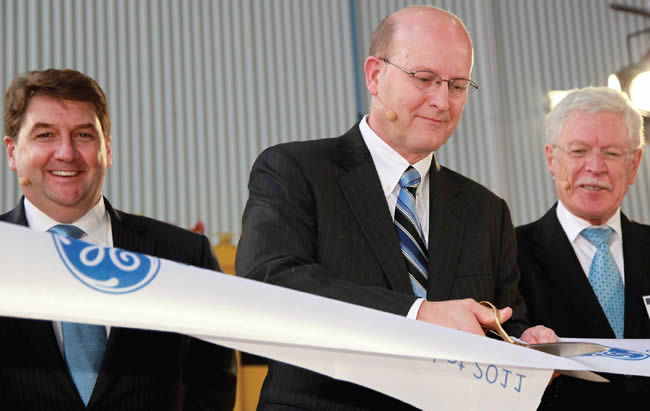
GE and Chevron executives opened a $100 million LNG and energy industry training centre in Western Australia focusing on equipment servicing |
GE has opened its $100 million technology and learning complex in Jandakot, Western Australia, to support the development of skills for the LNG and energy sector. GE, which supplies drivers for LNG liquefaction, said it expected to deliver 4,000 training days in 2012 and has already begun to service its major equipment in the country. “This will be the first GE facility to offer the full range of technical training required to meet both the demands of the resources boom in Australia and the need to increase productivity in the sectors facing this rising demand,” said GE. The service centre will be supporting, among others, key equipment employed in LNG Trains that compress and refrigerate natural gas, transforming it into liquid so that it can be transported. “Every day an LNG Train is out of action can cost up to $15M, so maximizing uptime and optimizing maintenance schedules plays a crucial role in productivity,” the company said. “Global energy demand is expected to grow 35 percent over the next 25 years and by 2020 Australia will be the biggest exporter of LNG in the world,” said Steve Sargent, Chief Executive of GE Australia. “Ensuring that Australia benefits fully from this boom requires us to develop skills and technical capabilities in country. This investment ensures that we are not only able to support our customers more effectively but we also support Australia’s long-term benefits,” Sargent said. Chevron Australia, which operates the Gorgon and Wheatstone LNG projects, is one of the energy companies set to train hundreds of its Perth, Australia-based engineering and technical staff at the GE facility. “Chevron had so far invested $12 million on recruiting and training 40 apprentices and trainees in preparation for when the Gorgon LNG and domestic gas plant became operational,” said Chevron Australia Managing Director Roy Krzywosinski. “Chevron also employs 120 university graduates across a range of oil and gas related fields. These are young people who are getting valuable experience on the front line and will be the leaders of the future,” Krzywosinski added.
GULF LNG, one of two projects being developed in Papua New Guinea, signed a preliminary deal with Gunvor Singapore for the supply of 1 million tonnes per annum of LNG, said key shareholders InterOil Corp. and Pacific LNG. The signing of the heads of agreement took place in the capital Port Moresby with members of the government present. Following recent criticism of the project and calls for more experienced LNG players to be involved, the government said it “supports the phased LNG development of the Gulf LNG project and the financial structure to ensure LNG revenue for all stakeholders by 2014 to early 2015.” Flex LNG of Norway and Samsung Heavy Industries of South Korea are developing a floating liquefaction plant for the venture. Philip Fjeld, Chief Executive of Flex, was also present at the signing, to “assure the PNG government that Flex LNG and Samsung can be ready for FID by year-end 2011, in line with the PNG government requests.” The LNG sales agreement with Gunvor is for a period of 15 years starting in 2015.The Gulf LNG project will liquefy feed-gas from the Elk and Antelope gas fields. InterOil Chief Executive Phil Mulacek commented: “We are pleased to have executed an HOA with Gunvor, for long-term LNG off-take from our Gulf LNG Project in Papua New Guinea. InterOil is proud to work with Gunvor, one of the largest energy commodity movers in the world. With 2.3 MTPA now committed under HOAs, InterOil has preliminary LNG offtake arrangements for more than 50 percent of its start-up LNG volumes. We expect the HOAs to facilitate remaining infrastructure financing arrangements with binding SPA, driving robust debt coverage for the Gulf LNG project.”
HOEGH LNG said it entered into an agreement with Daewoo Shipbuilding & Marine Engineering to initiate a project-specific front-end engineering design of an LNG floating production, storage and offloading project for the Tamar natural gas field offshore Israel. This agreement follows the recent announcement of a deal between a DSME and its Norwegian joint venture D&H Solutions and the Tamar field owners, Noble Energy, Delek and Isramco to exploit part of the Tamar field with a Floating LNG solution, Hoegh said. “The agreement states that Hoegh LNG with selected partners shall be the owner and operator of the LNG FPSO and that DSME shall be the EPCIC contractor, subject to further engineering work and a final investment decision,” Hoegh said. Hoegh President and Chief Executive Sveinung Stohle, explained: “We are excited about initiating the engineering work for an LNG FPSO to monetize the gas reserves in the Tamar field in Israel based on Hoegh LNG's already developed design. This is a result of Hoegh LNG's continuous effort over the past five years to promote technical and economical sound floating solutions for LNG production. We are pleased to work with DSME and the Tamar field owners in jointly developing one of the first LNG FPSOs to come to market. DSME has been our partner for several years and we are confident that together with the other Tamar partners we will design, construct and operate an excellent solution for bringing the Tamar gas to the market.”
ITALY’S classification society RINA has boosted its LNG interests by taking control of the energy consultancy D'Appolonia Group, recently involved in the Papua New Guinea liquefaction project and the Dunkirk LNG import venture in northern France. RINA Chief Executive Ugo Salerno said: “By bringing the D'Appolonia Group's 580 multi-disciplinary staff and 87 million euros of turnover into RINA we have made a quantum jump in size and capability. We have brought a lot of new skills and services into RINA, and we significantly strengthen our teams working on offshore energy and port development projects.” RINA said that in the offshore energy field, D'Appolonia has key skills in site engineering, geophysical surveys and investigations, seismic hazard evaluation, coastal engineering and environmental impact assessment. In the port development field, D'Appolonia has developed feasibility studies and designs for the Russian ports of Sochi and Taman, Beira in Mozambique and Ain El Ghazalah in Libya among others. Salerno said D'Applonia's expertise in construction, brownfield site recovery and materials handling especially complemented RINA's existing marine expertise. “Together we can add a strong global dimension to RINA's services, able to bring together marine and engineering knowledge with respect for the environment and deliver port and offshore projects safely and cleanly,” Salerno said.
LNG SHIPPING was still seeing strong worldwide demand. Existing tonnage was being chartered well in advance for new liquefaction projects and as new import facilities are planned worldwide. “Structural need for shipping continues to outstrip supply of tonnage, either forcing prospective charterers to adjust their requirements, or leave many potential chartering opportunities uncovered,” Golar LNG said in its quarterly overview of the industry. “While small windows of vessel availability will continue to exist in the form of backhaul and short intra-regional voyages, the tight shipping market has forced a number of charterers to take a more in-depth look at first generation vessels available for multiple month periods,” it added. The third quarter witnessed another run up in charter rates with spot rates hovering now around $110,000 per day, on a round trip basis, for modern steam vessels. “The anticipated structural tightness during 2012-2014 is expected to allow owners to continue to demand improved freight economics, driving improvements in both charter rates and charter periods,” Golar said. “There is currently a strong backwardation in the LNG shipping charter market. The company believes that this curve will flatten somewhat, particularly for three to seven year charter periods, as the major players realise the underlying strength of existing shipping demand,” the company added. The worldwide LNG fleet currently stands at almost 370 vessels, including FSRUs with a further 64 LNG carriers on order. “There is today very limited shipyard capacity available before the last quarter of 2014 and diminishing availability for 2015,” Golar said. “In the period 2014 to 2015, substantial new LNG supply is anticipated from Australia and the Middle East, which will require significant and as yet unsecured additional shipping capacity,” it added. Additional shipping capacity will also be needed to support the development of new liquefaction capacity, as well as the growing short-term/spot LNG trading business. “The development of potential US LNG export capacity will further increase the demand for tonnage. The demand for LNG shipping is also positively affected by the debottlenecking of existing liquefaction facilities, which gives rise to additional LNG production,” it said.
PAPUA New Guinea LNG project, being developed by ExxonMobil and partners, will cost more than planned because of the stronger Australian dollar, the shareholders have been told. Santos, the Australian energy company with a 13.5 percent stake, said it had been advised by the US company that due to currency issues the estimated capital cost of the project had risen by US$700,000 to US$15.7 billion. Santos said that for its share it would be paying about US$100M more into the project. “Santos is well positioned to manage the impact of a strong Australian dollar on project capital costs,” the company said. “The company's Australian dollar denominated balance sheet means that PNG LNG US dollar capital costs are translated into Australian dollars at current exchange rates. In addition, Australian dollar cash balances and domestic gas sales revenues provide effective protection in the event of a sustained appreciation of the Australian dollar,” Santos explained. The PNG LNG venture, consisting of two liquefaction Trains with combined capacity of 6.6 million tonnes per annum, remains on schedule for first LNG in 2014, Santos stated. The other shareholders in the venture are Oil Search (29 percent), National Petroleum Co. PNG (16.8 percent), Japan's Nippon Oil (4.7 percent), and Mineral Resources Development Co. (PNG landowners, 2.8 percent). A second LNG project in PNG, known as Gulf LNG and involving both Floating LNG and onshore facilities, includes companies such as InterOil, Pacific LNG partners and Norway's Flex LNG. Its phase-one estimated costs are around US$6Bln. The PNG government recently criticised InterOil's project plan as it had evolved on a different track from what had originally been approved. InterOil is also in the process of seeking an operating and equity partner with previous LNG development experience following a request by the government.
QATARGAS delivered its first Q-Max LNG cargo to China on board the 266,000 cubic metres capacity vessel “Bu Samra”, which unloaded at the PetroChina-owned receiving terminal at Rudong in Jiangsu province. The cargo was delivered from the Qatargas IV liquefaction Train in Ras Laffan under a long-term contract between PetroChina and Qatar Petroleum and Royal Dutch Shell. Qatar operates the world's largest class of LNG carrier in the Q-Max vessel, while its Q-Flex carriers are the second-largest with capacities of just over 210,000 cubic metres capacity. The deliveries to PetroChina under the Qatargas IV agreement will total 3 million tonnes per annum over 25 years. Qatargas Chief Executive Khalid bin Khalifa Al-Thani said: “The first Q-Max LNG cargo delivered to PetroChina's LNG terminal is a significant milestone meeting the growing demand for energy in China and we at Qatargas are very proud to have played this contributing role. This delivery will further strengthen the relationship between Qatargas and PetroChina over the long-term. We remain long-term partners of China.” In addition to co-owning the Qatargas IV LNG Train, Shell is also the operator of many of Qatar's LNG carriers through its shipping unit Stasco. Andy Brown, a Shell Executive Vice President and director of Qatargas IV, said: “Shell is proud to have facilitated the supply of LNG between Qatar, as the largest LNG producer in the world, and China with its large, burgeoning gas market. These agreements should be of tremendous benefit to both countries.”
QUEENSLAND Curtis LNG, the project being developed by BG Group through its Australian subsidiary QGC, has spent more than A$5.1 billion as it advances the first phase and the coal-seam gas tenements. The CSG-tot-LNG venture involves developing CSG in the Surat Basin and transporting it in a 540-kilometre underground pipeline network to a liquefaction plant near the port of Gladstone in eastern Australia. The spending figure for the past 18 months is part of a six-monthly report to the Queensland Coordinator-General on Australian industry participation in the QCLNG Project, QGC said. More than 4,300 people are also now working for QGC and the QGCLNG project which involves a total investment of more than A$15 billion, with the Australian dollar currently on par with the US currency. Of the total work force, 1,466 staff and contractors work directly for QGC while 2,880 are engaged by contractors on the QCLNG project, the report added. The latest report also marks the QCLNG project's first year of construction. The workforce numbers include 310 indigenous staff and contractors and nearly 100 graduates, trainees and apprentices, QGC said. QGC Senior Vice President Jim Knudsen said: “QGC had spent A$3.7 billion with Australian firms for goods and services, and nearly A$1Bln on local infrastructure such as roads and airports. While nearly A$3 billion has been spent across Queensland, the Western Downs region between Toowoomba and Roma has been the largest recipient of spending with more than A$230M, followed by the Banana-Gladstone-Rockhampton region with more than A$191M.” The QCLNG project has nearly 300 vacancies from professions and trades such as geology, drilling, engineering, construction, electrics and fitting to administration. QGC and its contractors had signed almost 1,000 contracts across the QCLNG project and more than 13,600 registrations of interest had been received from regional, Queensland and Australian firms to provide goods and services, the report said.
 |
|
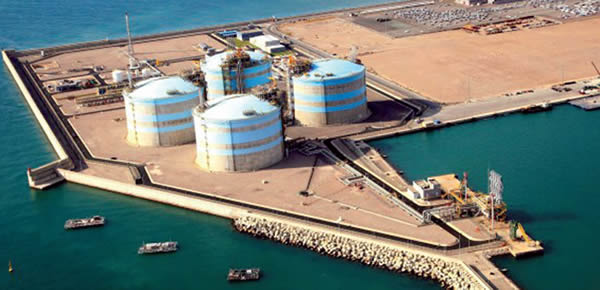
Sagunto LNG import terminal in eastern Spain, operated by GNF and with Osaka Gas as a shareholder, has put a fourth LNG storage tank into operation |
SAGUNTO LNG import terminal in eastern Spain, whose diverse ownership group includes Japanese utility Osaka Gas, Deutsche Bank and Oman Oil, has put a fourth LNG storage tank into operation at a time of much lower natural gas demand in Spain because of the economic downturn. Since it was built in 2006 to import LNG for the Valencia region of Spain, the terminal has extended its facilities, adding two new tanks and a fifth sea-water vaporiser. The new installations have doubled the plant's starting storage capacity and increased its regasification capacity by 33 percent. However, Spanish natural gas demand in November was at a five-year low for the start of winter. According to network operator, Enagas, the natural gas demand for power generation was down 35 percent compared with 2010, as Spain's combined-cycle gas turbines continue to be overshadowed by coal-fired power. Overall investment in the Sagunto facility, including the initial plant and the various additions, now stands at around $700 million. Part of the expansion was financed with a loan from the European Investment Bank. Sagunto has also extended its jetty facilities to accommodate the largest Q-Flex and Q-Max LNG carriers from Qatar. Current storage at the terminal is 600,000 cubic metres from its four 150,000 cubic metres tanks. Construction of the new fourth tank was carried out by a joint venture including Cobra Instalaciones of Spain, Sener Engineering, Japan's Toyo Kanetsu, Dywidag International of Germany. Since its entry into operation, the terminal has been one of the Spanish regasification plants with the greatest level of use relative to its installed capacity. Since January 2011, the terminal has imported around 60 LNG cargoes, or just over 2.5 million tonnes of LNG mostly from Egypt, Algeria and Qatar, though also from Oman, Libya, Trinidad, Norway and Yemen. Since the terminal went into operation it has seen major shareholders, Spanish utilities Iberdrola and Endesa, sell their combined 50 percent stakes. Osaka Gas agreed in 2010 to acquire a 20 percent stake in Sagunto from Endesa. The shareholders are now Gas Natural Fenosa, Osaka Gas, the real estate arm of Deutsche Bank, and Oman Oil. Sagunto LNG import terminal in eastern Spain has put a fourth LNG storage tank into operation
SANTOS, the Australian company leading the Gladstone coal-seam-gas-to-LNG project, completed its acquisition of Eastern Star Gas, giving it the largest natural gas reserves position in New South Wales. The GLNG project will involve piping CSG from Santos's eastern Queensland fields to a plant at Curtis Island off the port of Gladstone. GLNG will produce 7.8 million tonnes per annum of LNG through two LNG processing Trains, but the Eastern Star acquisition will underpin its proven reserves. Before the Santos takeover Eastern Star had considered joining another LNG project. Santos now operates and owns 80 percent of CSG) permits formerly held by Eastern Star,, taking its total NSW reserves position to 1,216 petajoules of 2P reserves and 2,238 PJ of 3P reserves. Santos Chief Executive David Knox said: “Santos is committed to ensuring that the CSG industry develops in the Gunnedah Basin without impacting the role the region plays as an important agricultural producer." The growth of the natural gas industry in the Gunnedah Basin has the potential to bring at least a thousand new jobs and hundreds of millions of dollars in additional investment to local communities across the region.” Santos said it acknowledged concerns expressed by local communities about some of Eastern Star's development plans. Over the next year, Santos said it would continue working with the community to progress plans to drill 15 pilot exploration wells and associated water monitoring bores, with a similar level of exploration over the following couple of years if the initial activity was successful. “Santos will spend about $500 million on this exploration research and all of the data we collect will be made freely available to the public and regulators for scrutiny and use in other public water resource studies and regulatory activities,” it added.
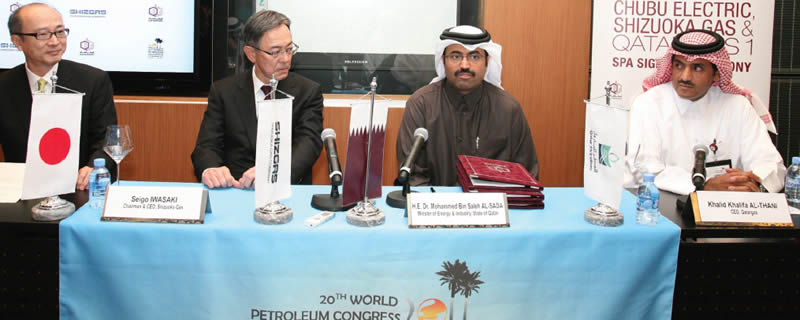
SHIZUOKA Gas Co., a Japanese utility, has become the latest LNG buyer to sign and LNG supply contract with Qatargas. Shizuoka and Chubu Electric Power Co., Japan's third-largest power company, reached a joint medium-term agreement with Qatargas to buy a total of 200,000 tonnes per annum of LNG for six years starting in 2016. Japanese utilities are making determined efforts to secure new LNG supplies as gas-fired power output grows to make up for nuclear power outages and shutdowns of reactors for safety reasons caused by the March disaster. The utilities are also putting aside corporate rivalries to bid more for LNG in consortia, as the country's power companies did when LNG was first imported to Japan in the late 1960s. Chubu signed its first long-term contract with Qatargas just after the start of LNG production in Qatar and is one of eight long-term Japanese customers receiving cargoes from the world's largest producer. Chubu has also been a buyer of incremental cargoes from Qatar and elsewhere to build up LNG stocks during 2011. The LNG for Shizuoka and Chubu under the new medium-term contract will be delivered to the Yokkaichi import terminal, operated by Chubu near the city of Nagoya, and to the terminals in Chita, Kawagoe, Joetsu and Sodeshi for the duration of the contract. Shizuoka has a customer base covering 10 municipalities between Tokyo and Nagoya along the coastline of the Pacific near Mount Fuji, and including Shizuoka and Fuji cities. Shizuoka said it was strengthening its procurement ties with Chubu to secure “the stable supply of LNG to the central region of Japan.” In 2010, Shizuoka signed an agreement to receive a small annual share of LNG imported by Osaka Gas. The latest Japan-Qatar LNG supply contract signing in Doha, involving (from left to right) Yuji Kakimi, Head of Fuels at Chubu Electric, Seigo Iwasaki, Chairman and Chief Executive of Shizuoka Gas Co., Mohammed Bin Saleh Al-Sada, Qatar’s Minister of Energy, and Qatargas CEO Khalid Bin Khalifa Al-Thani
 |
|
The latest Japan-Qatar LNG supply contract signing in Doha, involving (from left to right) Yuji Kakimi, Head of Fuels at Chubu Electric, Seigo Iwasaki, Chairman and Chief Executive of Shizuoka Gas Co., Mohammed Bin Saleh Al-Sada, Qatar’s Minister of Energy, and Qatargas CEO Khalid Bin Khalifa Al-Thani |
TAIWAN saw LNG imports rise more than 20 percent at the end of 2011, though the country is being overtaken by China as the third-largest LNG Asian importer after Japan and South Korea. China opened two new terminals in 2011, Dalian and Rudong, and has increased imports from countries such as Qatar. China now has five import facilities compared with Taiwan's two terminals, located at Tai-chung and Yung-An, and owned by state energy company CPC Corp. Last year Taiwan imported 11.2 million tonnes of LNG and China imported just under 10 million tonnes. Data from Taiwan customs shows that the country imported 1.1 MT of LNG in November in 17 cargoes compared with 918,183 tonnes in 14 cargoes in the same month last year. China was expected to overtake Taiwan earlier but a slowdown in its imports last year as new facilities were awaited enabled Taiwan to stay in front. China imports under long-term contracts with Indonesia, Malaysia, Qatar and Australia and also buys incremental cargoes. It's these spot buys which will edge out Taiwan in 2011. China's LNG imports have recently been just over 1MT a month. While China will soon have 15 or more LNG import terminals, Taiwan has no plans to build any new facilities. However, it will add three LNG storage tanks of 160,000 cubic metres capacity to the Tai-chung terminal by 2018. LNG and natural gas currently account for about 35 percent of Taiwan's total power generation mix. Taiwan's two terminals have a total of nine storage tanks with capacity of 1.17 million cubic metres. Tai-chung LNG terminal only became operational in 2009 but has since handled more than 100 cargoes.
 |
|
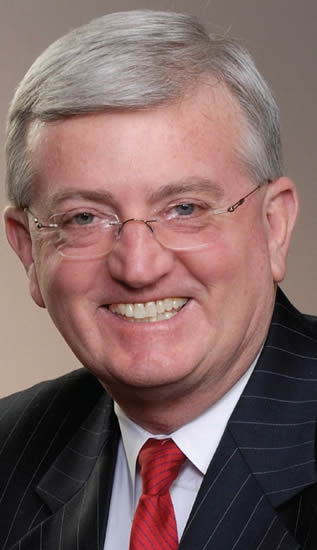
Randy Harl, President and Chief Executive of Houston, Texas-based Willbros. |
WARTSILA Corp. of Finland, the supplier of engines for LNG carriers and other vessels, has agreed a takeover of UK-based Hamworthy, the maker of ship-based LNG regasification systems, for around $580 million. The boards of Wärtsilä and Hamworthy agreed the transaction with the Finnish company paying 825 pence cash for each Hamworthy share. Hamworthy has just emerged from several difficult years but has recently posted new orders for regasification systems for Floating Storage Regasification Units to be used as LNG import facilities. The UK company has also recently increased research and development spending on two new technologies to help ships comply with new worldwide environmental regulations. The first helps reduce sulphur emissions and the second is used to treat ballast water. “The board of Wärtsilä believes that the combination would create an exciting platform in the offshore, marine gas and environmental solutions markets creating long-term growth to the benefit of shareholders, customers, and employees alike,” the Finnish company said. “Wärtsilä has strategically developed its Ship Power division in recent years beyond traditional engine technology to encompass ancillary equipment and systems, to be able to provide customers with more value added marine solutions,” Wärtsilä added. “Hamworthy would extend that strategy by offering excellent technology in strong market positions, on which Wärtsilä could leverage its international sales and service network,” it added.
WILLBROS Group, the US energy engineering and servicing company, said it signed a contract renewal to provide maintenance for the next five years at Oman LNG's Qalhat liquefaction plant at Sur. The Willbros Oman-based subsidiary, Oman Construction Co., was awarded the contract, which contains an option for three additional years and includes mechanical, electrical, instrumentation, civil, scaffolding, insulation and painting services. Oman currently operates three liquefaction Trains producing 10.8 MTPA of LNG. Randy Harl, President and Chief Executive of Houston, Texas-based Willbros said: “We are pleased to continue this assignment, which we have performed for over 10 years, and are privileged to again be selected. This is a testimony to the quality of our team in Oman and the strong relationship, built on solid performance we have developed with our client. We look forward to working with Oman LNG for many more years,” Harl said. Randy Harl, President and Chief Executive of Houston, Texas-based Willbros. The company has a long-term presence in Oman’s LNG industry.
WILLBROS




