





News Summary for June 2011
ABS, the American Bureau of Shipping classification society, released at the Nor- Shipping conference in the Norwegian capital Oslo a guide on the benefits of LNG as fuel for ships. The ABS said its “Guide for Propulsion And Auxiliary Systems For Gas Fuelled Ships” was published in response to the industry’s need for technical guidance for new construction and existing vessel conversion. The ABS said it considered the publication “to be the most comprehensive available to the industry” and provides criteria for the arrangements, construction, installation and operation of machinery components and systems for vessels fuelled by natural gas. The objective of the guidance is to minimize operating risks and promote the protection of the vessel, its crew and the environment, the ABS said. Christopher J. Wiernicki, ABS Chief Executive and President said that the shipping industry needed to examine the issues surrounding the transition from traditional fuels to LNG, to verify that solutions provide an equivalent level of safety and reliability to those established for LNG storage and transportation. “With ship operators facing economic pressures from fuel costs combined with impending regulations aimed at reducing exhaust gas emissions, particularly for sulfur oxide (SOx), LNG fueled propulsion systems could be a practical and beneficial solution. It is a matter of when, not if, LNG will be a commonly selected fuel source and we need a sound basis for ship designs,” said Wiernicki. More than 50 years of ABS’s experience with the handling and storage of LNG on board ships, many with dual-fuel diesel propulsion plants was incorporated into the Guide, it said. Consideration was also given to industry standards including the IMO Resolution MSC.285(86) Interim Guidelines on Safety for Natural Gas- Fuelled Engine Installations in Ships, the International Gas Carrier Code and the IMO International Code of Safety for Gas-Fuelled Ships, currently under development. Significant contributions to the Guide also came from a joint research project with South Korea’s Daewoo Shipbuilding and Marine Engineering and AP Moller Maersk to develop an LNG-fuelled containership. Concluded earlier this year, the project addressed the design and technical issues surrounding the use of a 7,000 TEU containership burning LNG as fuel for both propulsion and power generation, with ABS providing Approval in Principle for the resulting design. The study also assessed operational, economic and regulatory impacts from the use of LNG as a fuel source. Results from the study were presented by DSME in March during industry’s premiere gas conference, Gastech, in Amsterdam. “Natural gas has been used as a fuel for small regional non-LNG carriers working in environmentally sensitive areas,” said ABS Director, Environmental Technology Yoshi Ozaki who led ABS’s involvement in the project. “This study further supports technical feasibility of LNG fuel and suggests promise for a viable extended business line for LNG suppliers,” Ozaki said.
 |
|
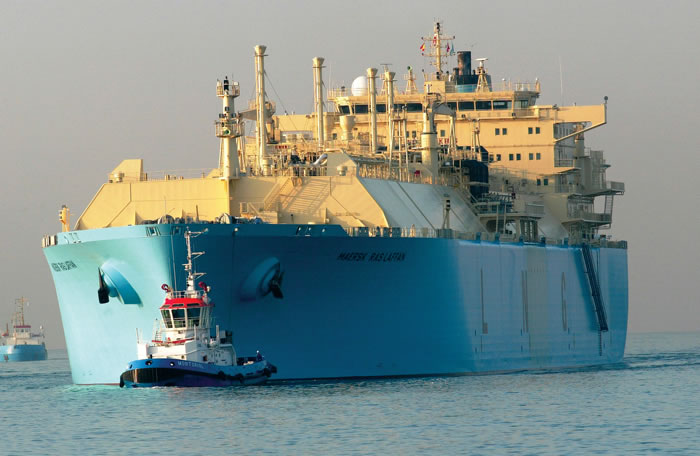
The ‘Maersk Ras Laffan’ in the Maersk shipping company’s distinct blue is part of the LNG fleet put up for sale |
AP Møller-Mærsk, the Danish shipping to- oil group, said it planned to “divest” its Maersk LNG subsidiary comprising eight LNG carriers just as the LNG shipping sector emerges from a three-year slump. The company, the world’s leading owner of container ships, announced the sale of Maersk LNG as it said first-quarter profits for its overall business rose by 82 percent in dollar terms to $1.1 billion from $639 million in the same period a year ago. Maersk LNG, which is part of the division including floating oil production vessels (FPSOs), returned profits of $12M for the quarter compared with a $72M loss in the first quarter of last year. However, the group said in its statement it was “going to the market to find a potential buyer for Maersk LNG” as the group wishes to reallocate resources. “The business has seen successful turnaround in the course of 2010, and is expected to generate profits and considerable cash flows in 2011 and the coming years,” the statement said. “The LNG market experienced increasing activity in the first quarter 2011 and all the group’s vessels were fully employed throughout the period. Maersk LNG signed contracts in the first quarter of 2011 with a positive impact for 2011 and 2012,” the company added. The LNG shipping sector has recovered in 2011 and the Danish company is likely to have no problems finding a buyer for its ships, analysts said. Maersk LNG took delivery of its newest LNG carrier, the “Maersk Meridian” in January 2010, which brought its fleet numbers to eight vessels. The “Maersk Meridian” was the last in a series of six 165,500 cubic metres capacity dual-fuel electric propulsion ships from the Samsung Heavy Industries yard in South Korea, including the “Maersk Ras Laffan”. The two other vessels in the LNG fleet have steam propulsion. There are 12 business units in the Maersk Group, including Maersk LNG, and Group Chief Executive Nils S. Andersen said he was still confident in “ the long-term future of our markets and not least our ability to continue to compete successfully.”
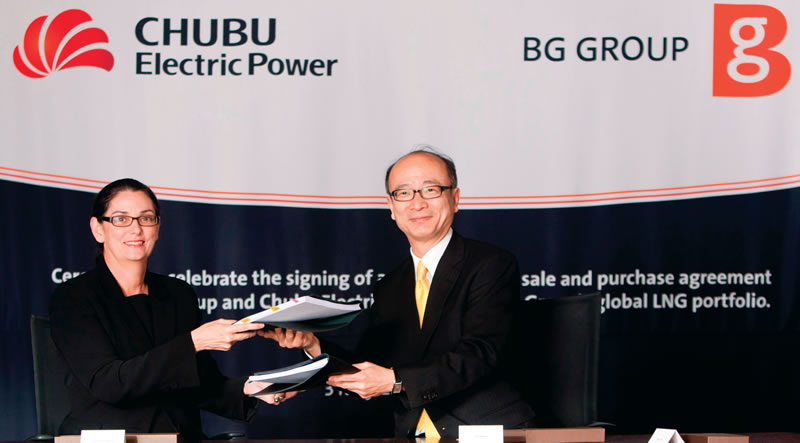
BG Group signed a sales and purchase agreement with Chubu Electric Power Co. for the long-term supply of LNG to the Japanese utility amounting to more than 120 cargoes. Under the agreement Chubu will purchase up to 122 cargoes over a period of 21 years, starting in 2014, BG said. The LNG will be supplied from BG’s global LNG portfolio, including the Queensland Curtis LNG (QCLNG) Project under development by BG's Australian subsidiary, QGC. BG Executive Director Martin Houston said of the transaction: “We are very pleased to have a long-term partnership with Chubu Electric, one of the most experienced and innovative LNG buyers globally, and proud that we can assist in meeting the long-term energy needs of Japan.” Executive Vice President of BG’s Australian operations and Managing Director of QGC Catherine Tanna said the agreement built on the already close and productive relationship between Chubu and BG. “We welcome Chubu Electric as a foundation customer of QCLNG,” Tanna said. In March 2011, BG signed a sales agreement with Tokyo Gas Co. for the supply of 1.2 million tonnes of LNG for 20 years from QCLNG. That agreement with Togas comes into force in 2015. QCLNG is also underpinned by sales agreements including 3.6 million tonnes per annum being sold to China National Offshore Oil Corp., some 1.7 MTPA destined for GNL Chile, and a 20- year agreement to supply up to 3 MTPA to customers in Singapore.
 |
|
Managing Director of BG Australia Region Catherine Tanna (left) and Managing Executive Officer of Chubu Electric Power Yuji Kakimi complete the 21-year sales and purchase agreement for supply of LNG, starting in 2014 |
BG posted a 14 percent drop in first quarter profits from its LNG shipping and marketing unit to $501 million compared with $585M in the same quarter a year ago BG said the profits drop was because the 2010 first quarter numbers “benefited from strong weather-related gas demand.” LNG operating profit for the whole of 2011 was expected towards the upper end of a $1.9 billion to $2.2Bln range,” the company said. “It was a challenging quarter for our E&P operations, with civil unrest in North Africa, flooding in Australia, an increase in UK tax and a shutdown in the North Sea,” said Chief Executive Frank Chapman. “We now expect modest production growth in 2011. The plans for a ramp-up in production in 2012 and 2013, as well as our 2020 goals, are unaffected and are supported by significant progress with our growth projects in Brazil, the USA and Australia,” Chapman added. LNG capital investment of $399M in the quarter included $366M in Australia, BG said. Among first-quarter highlights, BG cited a sales agreement with Tokyo Gas for the supply of 1.2 million tonnes of LNG a year for 20 years from 2015. Togas will be supplied with LNG from the Queensland Curtis LNG facility in Australia, and from the group’s global LNG portfolio. BG also signed a sales agreement with another Japanese utility Chubu Electric Power Co. for the supply of 122 LNG cargoes over 21 years, starting in 2014. “Progress continued with the QCLNG project during the quarter. Mitigation of the effects of the severe flooding, which has primarily impacted the drilling programme, is in hand with the 2014 first LNG date unchanged,” BG said.
CHENIERE Energy said it received an order from the US Department of Energy with authorization to export up to 16 million tonnes per annum of LNG to any country from the Sabine Pass LNG facility in Louisiana. The order expands on the authorization the Sabine plant received in September 2010 for the export of LNG only to Free Trade Agreement countries. It also concludes one of the key regulatory requirements necessary for the Sabine Pass liquefaction project from which the company intends to export liquefied natural gas from excess US supplies, Cheniere said. The authorization is conditional on the completion of the Federal Energy Regulatory Commission review process and on Sabine Pass starting export operations within seven years. “This concluding authorization by the DOE is a significant milestone for our liquefaction expansion project at Sabine Pass that will transform our terminal into the first bi-directional LNG processing facility capable of importing and exporting LNG,” said Cheniere Chief Executive Charif Souki. “Our terminal, designed with substantial operating flexibility and strategically located on the Gulf of Mexico, will provide customers the option to purchase or sell LNG from and to U.S. markets,” he added. “This is possible only because of the unique depth of the markets in the Gulf Coast, both on the production and consumption side; with approximately 30 Bcf/d of fully integrated physical supply, pipeline infrastructure, storage, and market delivery capability,” he said. “With the unprecedented growth in unconventional reserves, supply of natural gas continues to outpace demand dramatically. There are currently an estimated 3,500 wells that have been drilled but not completed with the potential to continue to boost production. The US has an opportunity to become a significant supplier in the global energy markets,” Souki added. Cheniere said construction of the Sabine Pass liquefaction facility is expected to commence in 2012 and be completed by 2015. Cheniere’s Sabine Liquefaction subsidiary has already entered into nonbinding agreements for an aggregate of up to 9.8 million tonnes per annum of processing capacity, well exceeding the targeted capacity of 7.0 MTPA to complete the first two Trains. Sabine has begun the process of converting its memoranda of understanding into definitive agreements whereby customers will secure their processing capacity under long-term take-or-pay contracts.
CHEVRON Corp. said it signed a Sales and Purchase Agreement with JX Nippon Oil for a portion of Chevron's offtake of LNG from the $40-billion Gorgon LNG project under development on an island offshore Western Australia. Under the binding agreement, JX Nippon will receive 0.3 million tonnes per annum of LNG from Gorgon for 15 years, Chevron said. John Gass, President of Chevron Gas and Midstream, welcomed the JX Nippon Oil transaction: “We are pleased to have JX Nippon Oil as a customer of the Gorgon project. Chevron has a longstanding relationship with JX Nippon Oil, and we look forward to continuing to grow our relationship.” Roy Krzywosinski, Managing Director of Chevron Australia, said: “The agreement is another step towards commercializing our equity natural gas in Australia, further demonstrating Chevron's leading ability to meet long-term demand growth in Asia-Pacific. Construction of the Gorgon project is progressing well with first gas expected in 2014.” Chevron is the operator of the Gorgon project and holds a stake of 47 percent. The initial Gorgon project development will include a three-rain, 15 MTPA LNG facility and a domestic gas plant. However, moves have already begun for the investors to build a fourth Train once the venture comes on stream. Chevron signed a similar supply agreement in January 2011 with Japanese utility Kyushu Electric Power for 300,000 tonnes per annum of Gorgon cargoes.
CLASS NK, or Nippon Kaiji Kyokai, the Japanese classification society, says it has new rules for floating offshore facilities for LNG production, storage and offloading. Class NK said that although the FLNG sector remains in its infancy, it is expected to grow rapidly in the near future and the new guidelines will address growing demand. “Ongoing environmental and logistical concerns related to onshore gas production have helped spur new interest in offshore LNG and LPG projects,” said Class NK Natural Resource and Energy Development Project Team Leader Hirofumi Takano. “With several of these projects entering the design phase, there has been a growing need for clear technical guidelines for the construction and survey of offshore gas facilities, and these new guidelines are an important step in that process,” Takano said. Due to their highly sophisticated nature, offshore gas facilities have primarily been evaluated on a project-by-project basis, and there has been a lack of clarity about which class rules need to be applied, a factor which these new guidelines address, Class NK said. “For example,” said Toshiyuki Shigemi, General Manager of the Class NK Development Department, “LNG FPSOs fall under both the scope of the our rules for FPSOs developed in 2009, as well as our rules for vessels carrying gas in bulk. With these new guidelines, however, we’ve a created a single reference for all the rules that apply to floating gas facilities.” Class NK said its guidelines are “more than just a compilation of existing rules” as they also incorporate a number of requirements exclusive to offshore gas facilities. “As floating structures, the design environmental conditions and mooring system are of great importance, so we’ve included complete information on analysis of environmental conditions and mooring systems, as well hull structural requirements, in our guidelines,” Class NK said. The guidelines also cover the wide range of other rules and requirements that apply to such structures, including rules for production machinery, piping arrangements and other equipment. The release of the “Guidelines for Floating Offshore Facilities for LNG/LPG Production, Storage and Offloading” follows closely on the official establishment of Class NK’s Natural Resource and Energy Development Project Team in February. “With this new team, we have brought together Class NK’s top experts from both the LNG and the offshore sectors, and these guidelines are the first result of our increased commitment to this growing sector,” Takano said.
EDF, the French utility and LNG player, said it’s going ahead with plans to develop an LNG import terminal near the Channel port of Dunkirk at a cost of around 1.5 billion euros ($2.2Bln). EDF said its Dunkerque LNG subsidiary will now invest the funds for the terminal to be built at Le Clipon. Approval has already been granted by the Dunkirk port authorities. The French company will be in partnership with several European natural gas companies in the project. “These will now be invited to confirm their participation, following EDF's commitment,” the company said. The terminal is expected to come into service in 2015 and give France a northern coast entry point for LNG. France’s current import network is concentrated on the Atlantic coast at Montoir-de-Bretagne and at Fos Tonkin and Fos Cavaou near the southern Mediterranean city of Marseilles, where the main importers are GDF-Suez and Total. The Dunkirk terminal will have an annual regasification capacity of 13 billion cubic metres of natural gas. “The new terminal will give EDF a balanced and diverse portfolio of sources for the supply of natural gas, allowing the group better to meet the needs of its final customers with dual energy offerings and optimizing supplies to its gas-fired power stations,” EDF said. “Within the Dunkirk region the project will have a formative impact on employment, recruiting up to 1,850 people during construction work on the terminal between 2012 and 2015. Once in operation, the facility will create around 250 jobs in either direct operation of the terminal or other port professions.” Three project managers will be jointly responsible for carrying out the project: the Grand Port Maritime de Dunkerque will build the port infrastructure, EDF the industrial installations and GRTgaz the connections to the gas transport network.
EXMAR, the Belgian shipping group with LNG interests, said it teamed up with Pacific Rubiales to develop a smallscale LNG export project in northern Colombia. Pacific Rubiales, a Colombian- Canadian exploration and production player, and Exmar have begun front-end engineering and design for the project. Plans involve building a small liquefaction barge and a pipeline from the company’s La Creciente gas field to the Caribbean coast and shipping to targeted markets. The project developers hope to export LNG to Caribbean and Central American markets, Exmar said. Technical details of the venture were not released. Exmar currently has an interest as an owner, part owner or manager of nine LNG vessels, including several in partnership with Excelerate Energy of the US and used as floating LNG import facilities. The Antwerpbased company is also branching out from the LNG shipping sector to expand its activities along the LNG value chain. Pacific Rubiales, based in Canada, produces natural gas and heavy crude oil, It also owns a company called Meta Petroleum Corp., a Colombian oil operator with interests in the Rubiales and Piriri oil fields in the Llanos Basin in association with Ecopetrol, the Colombian national oil company. Pacific Rubiales, whose shares are traded on the Toronto Stock Exchange, also owns all of the La Creciente natural gas field in the Sucre region of northern Colombia.
EVERETT LNG import terminal in Boston, Massachusetts, owned by GDFSuez subsidiary Distrigas, has for the first time sold LNG as vehicle fuel because the price of LNG reaching the US is lower than the price of diesel fuel and gasoline. The GDF-Suez facility is selling the LNG to a refuelling station for a fleet of waste collection trucks owned by a company called Enviro Express in Bridgeport, Connecticut. “Interest in LNG to power fleet vehicles is increasing significantly as diesel fuel and gasoline prices continue to climb,” said Joe Murphy, vice president, Sales and Transportation for Distrigas in the US. “The difference in fuel and maintenance costs and the environmental benefits make LNG an attractive vehicle fuel alternative,” Murphy said. The Everett LNG receiving terminal, which began operations in 1971, currently supplies regasified LNG cargoes to most of the natural gas utilities in New England. The transaction to use imported LNG for truck fuel is partially funded by the American Recovery and Reinvestment Act of 2009, and the $6.2 million project is also part of the larger Connecticut Clean Cities Future Fuels project. The growing shale-gas developments in the US has led to a re-think on how to adapt to the lower natural gas price environment in the US compared with Europe and the Asia-Pacific region. In addition to projects for using LNG as truck fuel some US LNG import terminals plan to build liquefaction facilities to export surplus and lower priced US natural gas. Distrigas says that by switching to LNG, the truck fleet users will be able to replace their purchase of about 500,000 gallons of diesel fuel annually and remove hundreds of tonnes of harmful emissions from the air. Adding to the environmental benefit, the Bridgeport fueling station is a closed system which recaptures boil-off from the LNG that would otherwise vent into the atmosphere and compresses it to be stored as compressed natural gas. “LNG is lighter than diesel, so we can go farther, cleaner, and improve load efficiency by hauling more with the same vehicle,” said Bill Malone of Enviro Express.
GDF-SUEZ said it agreed to sell 2.5 million tonnes LNG to Malaysian state energy company Petronas over a 42- month period starting in August 2012 following similar supply deals with Korea Gas Corp. and China National Offshore Oil Corp. Petronas is constructing an LNG import terminal in Malacca on the western coast of Malaysia, with capacity to regasify of 3.8 million tonnes per annum of LNG. The Malaysian company is the second producer in the Asia-Pacific to decide on LN imports after Indonesia. The two Asian countries supply their LNG under long-term contracts to countries such as Japan but are seeking their own LNG volumes for domestic use as natural gas demand increases. The GDF-Suez LNG cargoes will be sourced from its portfolio, which includes offtake from Algeria, Egypt, Nigeria, Norway, Trinidad & Tobago and Yemen. The French company currently has 16.5 million tonnes per annum of LNG supplies and is also set to establish a project presence in the Asia-Pacific region through its development plans in Australia. GDF-Suez is developing the Bonaparte LNG project offshore Australia. The company hopes to produce 2 MTPA of LNG from a floating production, storage and offloading unit in what will be one of the world’s first FLNG production projects. Gérard Mestrallet, Chairman and Chief Executive of GDF-Suez, said of the medium-term contract with Petronas: “This agreement concluded with Petronas LNG confirms GDF-Suez’s ambition as illustrated by other medium-term agreements recently concluded with Kogas for the delivery of 2.5 MTPA LNG between 2010 and 2013, or with CNOOC for the delivery of 2.6 MTPA of LNG from 2013 to 2016.” Petronas itself has a growing portfolio of interests along the LNG chain. In addition to its LNG production plants in Bintulu, Malaysia, the company has a stake in the Egyptian LNG plant at Idku, the Gladstone LNG project in Queensland, Australia, and the Dragon LNG import terminal in the UK. GLNG, the coal-seam-gas to-LNG project on being developed on Curtis Island by four companies led by Australia’s Santos, formally launched the US $16-billion venture at a ceremony in Queensland attended by politicians and executives. The GLNG project sees Santos team up with Petronas of Malaysia, France’s Total and Korea Gas Corp., for what is one of four CSG-to-LNG ventures in the area around the eastern Australian port of Gladstone. The Santosled project will bring CSG by way of a 420-kilometre from the Bowen and Surat Basins in south-east Queensland to a liquefaction plant where two Trains will produce a combined 7.8 million tonnes per annum of LNG. First LNG is expected in 2015 and two of the shareholders, Petronas and Kogas, have already signed up as purchasers of 7 MTPA of the offtake. The original GLNG developers, Santos and Petronas, brought in Total and Kogas to spread the costs of the multi-billion project. Santos is still the largest shareholder with a 30 percent stake in GLNG while Petronas and Total each hold 27.5 percent. The Kogas stake is 15 percent of the project. Australian Prime Minister Julia Gillard officially launched work on the GLNG project at Gladstone where three other projects are also under development involving companies such as BG Group of the UK, ConocoPhillips and Royal Dutch Shell. “Construction on Curtis Island heralds an economic boost for Gladstone, Queensland and Australia - and represents another significant commercial and strategic link between Australia and Asia,” said Santos Chief Executive David Knox. “Over the life of the project, GLNG will pay around A$40 billion in Federal Income Tax,” he added. Queensland Premier Anna Bligh said the GLNG project had already added over A$2Bln to Queensland’s economy and would make a “substantially greater” contribution, including the creation of 6,000 jobs. Knox added that the start of work on the GLNG plant was the culmination of more than three years of planning and preparation. “Curtis Island is the engine room for the whole project,” Knox said. “This is where coal-seam gas from Queensland’s world-class fields will be converted to LNG and exported to Asia,” he said. “The growing demand for natural gas in Asia is driven by the region’s need for cleaner, secure, safe and reliable energy - and that’s what GLNG will provide,” Knox stated. GLNG alone will supply 11 percent of Korea’s domestic gas needs and 9 percent of Malaysia’s gas consumption.
INPEX Corp. of Japan said it would extend the reach of its LNG imports by building a new pipeline linking the cities of Itoigawa and Toyama to its planned Joetsu LNG import terminal. The 102- kilometres Toyama Line along a coastal route will supply LNG-sourced natural gas to Nihonkai Gas Co, and other customers, starting in late 2014, Inpex said. It is one of the first additional energy infrastructure projects announced since the March earthquake and tsunami caused widespread damage to existing structures, including the Fukushima nuclear power generating facilities owned by Tokyo Electric Power Co. The new pipeline will be part of the natural gas transmission network linking the Tokyo metropolitan areas on Honshu Island and seven other cities, it added. The new Inpex LNG import terminal is in the port of Naoetsu in Joetsu city and is part of a build-up of Japan’s LNG terminal network and gas-fired power generation facilities. Japanese LNG imports are set to rise even more than previously forecast to meet power generating shortfalls caused by the earthquake.
JGC Corp., the Japanese LNG engineering company, overhauled its executive team and appointed a new President to “strengthen and rejuvenate” its management structure. The Japanese company has been at the fore-front of the development of the LNG industry and over the past 20 years has worked on the building of the world’s main liquefaction plants in countries such as Nigeria and Qatar. Koichi Kawana was appointed as the new President to succeed Masahiko Yaegashi. In addition, four executives have been promoted to more senior positions, with Masayuki Sato named as the new Managing Director and Chief Financial Officer. The appointments are effective from June 29, 2011, after the annual meeting of shareholders, JGC said. Other appointments include Tadashi Ishizuka as Executive Vice President and director, and Yutaka Yamazaki and Eiki Furuta as Senior Managing Directors. Six other senior executives retired, the company said. Kawana, the new President, is aged 54. He joined the company in 1982 and after working in London and the Middle East has held a string of senior positions in the JGC Global Marketing Division. JGC is currently working on the new Hachinohe LNG import terminal in Japan for JX Nippon Oil. The terminal will be Japan’s 28th import facility. JGC has built more than one third of Japan’s LNG terminal network.
LAKE CHARLES LNG import terminal in Louisiana is seeking to become an LNG exporter. BG Group of the UK and Texas-based Southern Union Co. applied for US permits to export 15 million tonnes per annum from the facility. A joint venture company called Lake Charles Exports has applied to the US Department of Energy for an export permit lasting 25 years. “The companies are jointly developing plans to install liquefaction facilities that would permit gas to be received by pipeline at the terminal and liquefied for subsequent export,” the application said. BG up until now has been the leading importer of LNG into the US with its capacity rights at the Lake Charles LNG terminal and at a second import terminal at Elba Island in Georgia. The move by BG and Southern follows similar applications by the owners of the LNG facilities at Sabine Pass in Louisiana, Freeport in Texas and Cove Point in Maryland to export US natural gas surpluses created by the development of the shale-gas industry. All the LNG facilities involved were established as importers until the slump in US gas prices made LNG imports into the US uneconomic as cargoes were diverted to higher priced markets in Europe and the Asia-Pacific region. BG has been building up its stakes in US shale-gas resources. Over the past two years, BG has purchased major interests in the Haynesville and Marcellus shale plays, as well as other production in Texas, Louisiana, West Virginia and Pennsylvania. The Lake Charles LNG terminal is one of the oldest in the US, having been certified by the US Federal Energy Regulatory Commission since 1977. BG has been an importer there since 1982. BG has brought LNG into Lake Charles from the Atlantic LNG plant in Trinidad and from other LNG liquefaction holdings, such as Equatorial Guinea LNG in West Africa owned by Marathon Oil, and elsewhere. The Lake Charles terminal currently has four large LNG storage tanks with capacity of 425,000 cubic metres. The terminal’s natural gas liquids processing facilities allow the extraction of ethane and other heavier hydrocarbons from the LNG stream. “Following completion of the project, the Lake Charles terminal will be bi-directional, and its peak and sustained send-out capabilities will not be affected,” the companies said.
LITHUANIA, the Baltic state formerly a part of the Soviet Union, could become an importer of LNG from the US after an agreement signed with Cheniere Energy of Houston, Texas. Cheniere plans to produce LNG at its Sabine Pass LNG facility in Louisiana and said it signed a memorandum of understanding on supplying LNG to Lithuanian oil terminal owner and LNG terminal developer, Klaipedos Nafta, at Lithuania’s embassy in Washington D.C. Lithuania has just announced plans to build an LNG import terminal to receive up to 2.2 million tonnes per annum at a facility to be built at the port of Klaipeda, where Klaipedos Nafta already operates a crude oil and oil products terminal. “Due to intensive shale-gas developments, the US has the potential to become a meaningful exporter of natural gas, which would not only benefit our project but our country as well, by providing a more diversified source of supply in Lithuania and boosting energy security,” said Rokas Masiulis, General Manager of Klaipedos Nafta. Charif Souki, Chief Executive of Cheniere, said: “Exporting LNG to Lithuania will allow one of our allies to diversify its natural gas supply, increase its energy security and strengthen its economy. We look forward to working with Klaipedos Nafta on developing solutions for their natural gas needs in Lithuania.” Klaipedos Nafta is in the process of building the first LNG import terminal on the Eastern Baltic coast for Lithuania’s needs and potentially for export to its Baltic region neighbours, Latvia and Estonia, as a supplement to Russian natural gas supplies. “The development of the Klaipeda LNG terminal is a critical component in the plan to open the energy markets in the Baltic region,” the statement said. Under the agreement just signed, Cheniere and Klaipedos Nafta will proceed with negotiations on a firm LNG supply deal. Cheniere is one of four US LNG import terminal owners planning to export LNG because US shale-gas developments are expected to produce a surplus of natural gas at prices that would make exports from the US economic.
MEO, the Australian developer of the niche Tassie Shoal LNG and methanol project in the Timor Sea, has signed a deal with Italy’s ENI to secure funding for exploration and appraisal drilling of nearby natural gas discoveries. The binding agreements give ENI a 50 percent in the Heron gas discovery in exchange for funding two wells and similar options on its Blackwood discovery in the same area. Tassie Shoal is centrally located to seven undeveloped gas fields within a 150 kilometres radius. MEO holds 100 percent equity in two of these fields, Heron and Blackwood. The latter is a modest-sized gas resource with high CO2 content. In contrast, the Heron field has the potential to host an LNG scale gas resource with potential to have higher quality (i.e. lower CO2) gas. MEO has secured its development location and environmental approvals to construct and operate a single 3 MTPA LNG plant and two 1.75 MTPA methanol plants on Tassie Shoal, an area of shallow water in the Timor Sea, some 275km north-west of Darwin. Previous Heron field drilling was the subject of cyclone interruptions and a collapsed borehole, meaning the well had to be abandoned prior to being fully evaluated. MEO then began a process of seeking a farm-in partner to assist with appraising and potentially developing the discovery and has now announced the partnership with the Italian energy company. For the Heron agreement ENI will earn 50 percent of the Heron gas discovery by funding MEO’s costs for the drilling of two wells and ENI will be the operator of the permit. ENI has 60 days after the first well has been drilled to elect to either drill a second Heron well or withdraw from the agreement, a statement explained. ENI also has an option, exercisable within 60 days after the first Heron well has been drilled, to elect to earn 50 percent in the Blackwood gas discovery by carrying MEO’s costs of acquiring a minimum of 500 square kilometres of 3D seismic and drilling one well in the Blackwood area. The Italian company has a further option to acquire an additional 25 percent interest in both discoveries by funding MEO’s share of the work programme required to reach a Final Investment Decision (FID) in either Heron and/or Blackwood, upon achievement of which ENI will make a one off bonus payment of US$75 million to MEO. “This agreement is in line with MEO’s strategy to partner with leading companies to unlock value in its portfolio,” MEO said. “Following successful appraisal of the Heron and/or Blackwood gas discoveries the joint venture will evaluate all potential commercialisation paths for the resources,” it added.
PETRONAS of Malaysia and Progress Energy Resources of Canada signed a US$1.7-billion deal for the Malaysian company to invest in shale-gas assets and develop an LNG export terminal project on the west coast of Canada. Canadian mid-sized energy player Progress said Petronas would pay US$273 million in cash by the third quarter of 2011 and a further $US824M towards capital spending by Progress to develop its British Columbia shale-gas holdings in the Montney region over the next five years. Petronas will additionally provide a standby equity financing commitment of up to US$615M for Progress's capital needs for development of the LNG export venture. Petronas will own 80 percent of the LNG project and Progress the remainder. The Malaysian company joins Apache Corp., EOG Resources, Shell and various other players who are planning LNG exports to the Asia-Pacific region from shale-gas resources in Western Canada. Petronas is currently the world’s third-largest producer of LNG from its Bintulu complex in Malaysia comprising three LNG plants. In addition, the Malaysian company also has a substantial stake in one of the main coalseam- gas-to LNG projects being developed in Australia by domestic producer Santos. Under the Petronas- Progress deal in Canada, Progress will sell 50 percent of its working interest in its Altares, Lily and Kahta properties in Montney to Petronas, the statement added. “We are very pleased to form this long-term partnership with Petronas,” said Michael Culbert, President and Chief Executive of Progress. “They share our belief that our North Montney shale assets are a world-class resource that deserves significant investment. We look forward to benefitting from Petronas’s significant global expertise including their leadership in developing infrastructure and accessing LNG markets,” Culbert added. “This partnership will also generate substantial economic benefits for local communities and the province of British Columbia, while leveraging the environmental benefits of Canada’s abundant and clean-burning natural gas resources globally,” he said. The LNG export joint venture will launch a feasibility study to evaluate building and operating the new LNG export facility on the west coast of British Columbia. Petronas would be the operator of the LNG facility, and both companies would jointly market the LNG. “Canada is poised to take a larger role on the world’s energy stage,” said Culbert. “Developing new export options for Canadian natural gas producers is a logical step in connecting our vast resources with growing Asian demand,” he added. “We look forward to working with West Coast British Columbia communities as we pursue this opportunity to build a new facility that will add value to British Columbia’s natural resources while creating considerable long-term local economic benefits,” he said. For the shalegas assets part of the transaction, Petronas will own 50 percent of the North Montney joint venture comprising 149,910 working interest acres and Progress will be the operator. The North Montney lands represent about 20 percent of Progress’s rights in its northeast British Columbia Foothills land holdings, which total around 700,000 net acres. Progress holds about 900,000 net acres of Montney rights over its entire British Columbia and Alberta land base, making it one of the largest Montney land rights holders. The Canadian company said the joint venture shale-gas properties “included five wells with minimal production at this time.” The closing of the transaction is subject to the execution of definitive agreements and receipt of regulatory approval, the statement concluded.
 |
|
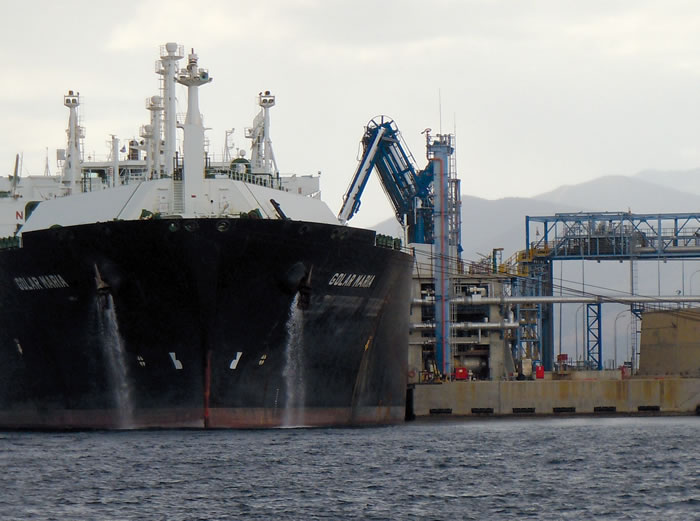
An LNG cargo from Qatargas being delivered recently to the Revithoussa LNG import terminal in Greece |
QATARGAS, the world’s largest corporate producer of LNG, said it added Greece to its roster of customers when a first cargo was delivered to the Revithoussa Island LNG import terminal, located west of the Greek port of Piraeus. The cargo was sold to the Netherlands-based hydrocarbons trading company Vitol, which was acting on behalf of Greece’s state-owned natural gas supply company DEPA. The 141,000 cubic metres capacity LNG carrier “Golar Maria” delivered the cargo to Greece rather than one of the large Qatari carriers as the Greek terminal can only handle conventional-sized ships, and because of the nature of the cargo transaction. “Due to Revithoussa’s small regas terminal capacity, the ‘Golar Maria’ was found well suited to the expected discharge quantities to keep boil-off gas to a minimum between parcels,” Qatargas said. Commenting on the first LNG shipment by Qatargas to Greece, Khalid Bin Khalifa Al-Thani, Chief Executive of Qatargas, said: “We are pleased to supply LNG where it is needed most. Greece is the latest addition to our growing customer portfolio in Europe and we are happy that our LNG will keep the lights on in Athens.” Europe is currently one of Qatargas's largest markets accounting for around 45 per cent of delivered cargoes. Qatargas produces 42 million tonnes per annum from its seven LNG trains, four of which are the world’s largest with output of 7.8 MTPA each.
SHELL said it signed a heads of agreement for the long-term supply of two million tonnes per annum of LNG to CPC Corp. of Taiwan. Shell said its Shell Eastern LNG subsidiary agreed the transaction with the Taiwanese energy company for a period of 20 years starting in 2016. This is the first long-term LNG deal between Shell and CPC and the agreement will see Shell become one the main suppliers of LNG to Taiwan, a statement said. The terms of the HOA provides for CPC and Shell to work together and conclude detailed sale and purchase agreements in the coming months. Taiwan’s CPC opened a second LNG import terminal two years ago as its cargo requirements have grown. However, the emergence of China as an LNG buyer has meant more competition in the Asia-Pacific region for long-term supplies at economical prices. Taiwan is currently the fourth-largest LNG market in the Asia-Pacific region in terms of long-term supply contracts behind Japan, South Korea and now China. Taiwan’s newest terminal, the Tai-Chung facility, has three LNG storage tanks, each with a capacity of 160,000 cubic metres. Its Yung-An LNG terminal in southern Taiwan has six storage tanks with combined capacity of 690,000 cubic metres. Among Taiwan’s other supply contracts are one with Qatar’s RasGas for 2.7 MTPA over 25 years, and three contracts with suppliers in Indonesia and Malaysia for more than 5 MTPA.
STENA, the Swedish shipping company, said it bought three LNG carriers for $700M from the Taiwanese company TMT and expected charter rates of over $100,000 per day from each vessel. One of the vessels was built in 2006 with 145,000 cubic metres capacity and was renamed the “Stena Blue Sky”. The other two carriers are new-builds of 174,000 cubic metres capacity. They were completed in 2010 and have been renamed the “Stena Clear Sky” and the “Stena Crystal Sky”. “The three tankers are all ultra-modern and ice-classed. The ‘Stena Blue Sky’ is currently chartered by Russian Gazprom with 22 months remaining on its contract,” Stena said. The carriers will be under the operational control of Stena Bulk, whose President Ulf G. Ryder, said: “We believe this to be a very good investment. LNG accounts for a significant part of the growth in the global energy supply and there is currently a shortage of LNG tankers. Consequently, we expect the two newly built vessels to directly command freight rates in excess of $100,000 per day.” Capacity utilisation of the 359 LNG carriers worldwide has soared in the past eight months with global LNG demand. The Japanese earthquake and tsunami in March further tightened the market as spot cargo deliveries were arranged by utilities in Japan which is the world’s largest LNG buyer. According to Stena, the demand for transportation of LNG is expected to rise about 8 percent per annum over the next 10 years. “Having in this situation the liquidity and operational know-how to be able to purchase these three vessels so quickly, two of which are so new that they have not even been delivered from the shipyard yet, gives our LNG investment an excellent starting point,” Ryder stated.
TECHNIP, Europe’s leading LNG and energy engineering company, has two new woman directors, bringing to three the number now sitting on the French firm’s board as part of a diversity policy. The French company's annual meeting ratified the co-option of Marie-Ange Debon announced earlier and approved the nomination of two new female directors, C. Maury Devine and Leticia Costa. Technip said the new appointments brought the percentage of women on the company’s Board to 27 percent (three out of 11), satisfying the legal objective for French companies of 20 percent by 2014. “They are also part of a wider aim to renew and diversify the composition of the Board, which now includes American and Brazilian members who have an in-depth understanding of the group’s major clients and markets such as North America, the North Sea and Brazil,” Technip said. Marie-Ange Debon is General Secretary of the Suez Environnement Group and is a member of the College de l'Autorité des Marchés Financiers (the French Financial Market Authority). Prior to joining Suez Environnement in 2008, Debon has served in various positions in both the public and private sectors. Marie-Ange Debon is a graduate of the Paris business school, the École des Hautes Études Commerciales, and the Ecole Nationale d' Administration and has a Master's Degree in Law. C. Maury Devine is a member of the Board of FMC Technologies and John Bean Technologies. She serves on the Audit Committee and Nominating and Governance Committee of both companies. She is also a member of the Council on Foreign Relations and is a member of the independent Nominating and Governance Committee of Petroleum Geo Services. She served as Vice- Chairman of the Board of Norway’s Det Norske Veritas from 2000 to 2010, and was a fellow at Harvard University’s Belfer Center for Science and International Affairs between 2000 and 2003. Additionally she held various positions in ExxonMobil Corp. between 1987 and 2000, notably President and Managing Director of ExxonMobil’s Norwegian affiliate from 1996 to 2000. From 1972 to 1987, she held various assignments in the US government notably in the US Department of Justice, the White House and the Drug Enforcement Administration. She is a graduate of Middlebury College, the University of Maryland and Harvard University (Masters of Public Administration). The third woman Board member, Leticia Costa, has been a partner in Prada Assessoria and Coordinator for the Center of Strategy Research at Insper. In January 2011, she became a Director of the Automotive Engineers Association in Brazil. She currently serves as board member of FAMA, a private equity fund in Brazil, of Localiza, the largest car rental company also in Brazil and of Sadia, a food manufacturer. In 1986, she joined Booz & Co. (formerly Booz Allen Hamilton) and in 1994, became a Vice President and in 2001 was appointed President of the operations in Brazil. She also served the firm’s Board of Directors. At Booz & Co., Costa completed a wide range of assignments in Europe and Latin America, and also conducted studies in North America and Asia. Prior to joining Booz & Co., she worked from 1982 to 1984 as a systems analyst for Indústrias Villares S.A. Costa is a graduate of Cornell University and of Escola Politécnica of the University of São Paulo.
TIDELAND Signal of the UK was chosen to supply all the warning lights and buoys for the new Dubai Supply Authority floating LNG import facility at Jebel Ali port in the United Arab Emirates. This is the latest in the list of Tideland's LNG installations around the world. The company has previously supplied equipment for the port at Soyo in Northern Angola, India's Dabhol Port, Milford Haven in the UK, the Burrup Peninsula terminal near Karratha in Western Australia and Yemen's LNG terminal at Balhaf, on the Gulf of Aden. The Dubai LNG facility will be protected by five special marker buoys, three fixed navigation beacons installed on the breakwaters and six beacons equipped with Tideland's newest MLED-150EX lanterns installed on the LNG wharf, the company said. The buoys are Tideland's SB-138 polyethylene units complete with mooring equipment and SolaMAX-140/6 self-contained marine lanterns fitted with the MaxiHALO-60 LED flasher. The breakwater beacons, also solar-powered, are Tideland's MaxLED-200 MaxLumina lanterns, supplied complete with solar arrays, maintenance-free batteries/ battery boxes and mounted on two-metre galvanized steel stanchions. One of the company's earliest port equipment installations was for the Atlantic LNG plant in Trinidad. The UK company is part of the Tideland group whose headquarters are in Houston,. Texas.
 |
|
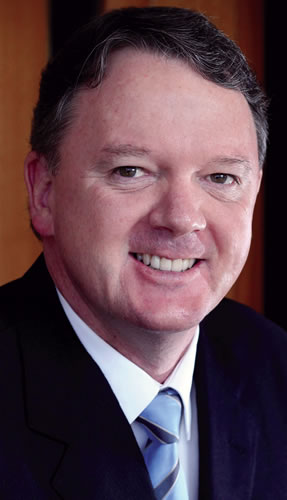
Peter Coleman joined Woodside Petroleum from ExxonMobil as new CEO of the Australian company |
WOODSIDE Petroleum, the Australian LNG producer and developer, appointed Peter Coleman from ExxonMobil to replace Don Voelte as Chief Executive with salary and benefits of over $2 million a year and a signing-on package of around $3.6M in cash and shares. Voelte, a US citizen from Nebraska, announced in October 2010 he was retiring from Woodside after seven years when he built the Australian company up to be a leading LNG player. Woodside is currently bringing the Pluto LNG project on stream and developing two other projects, Browse LNG and Sunrise Floating LNG. It is also a onesixth shareholder in Australia’s first LNG plant, the North West Shelf facility at Karratha. Coleman, an Australian citizen from the state of Victoria, goes to Woodside after 27 years with ExxonMobil, where he filled a variety of roles in Australia, Africa, Asia and the United States. Coleman’s most recent position was Vice President of the ExxonMobil Development, with responsibility for oil and gas developments around the world. This included ExxonMobil’s Papua New Guinea LNG project and oil and gas developments in Malaysia, Indonesia and Australia. Previous key roles with ExxonMobil included Vice President, Americas, responsible for all activities related to production in the US, Canada and South America. Coleman joined ExxonMobil from its Australian subsidiary Esso. Woodside Chairman Michael Chaney said Coleman’s appointment followed an extensive recruitment process which “considered a strong field of internal and external” candidates. “The board is delighted that Mr Coleman has agreed to lead Woodside through the company’s next phase of growth,” Chaney said. Chaney paid tribute to the achievements of Voelte, who will step down as CEO and Managing Director at the end of the month. “Mr Voelte oversaw a significant expansion of Woodside’s LNG portfolio and created a strong ‘can do’ culture within the company,” Chaney said. “He has made an enormous contribution during his tenure, leaving Woodside in a great position from which it can continue to build,” he added. Coleman said he was excited to be joining Woodside, a company he had long admired. “I have followed Woodside closely since beginning my career in the oil and gas industry nearly three decades ago and I relish the opportunity to lead this great Australian company,” he said. “Woodside has an impressive portfolio of Australian oil and gas assets right across the development timeframe and I look forward to growing the company as successfully as my predecessors, and in a manner which continues to provide superior returns to shareholders,” Coleman added. Voelte welcomed Coleman’s appointment, saying his wide industry experience and unique oil and gas skills would stand him in good stead in his new role. “I am confident that Mr Coleman has the right qualities to take Woodside through its next phase of growth,” he said.
WOODSIDE entered into an agreement to sell US$700 million of corporate bonds into the US bond market for institutional investors. The bonds were to be issued by Woodside Finance Ltd, a wholly owned subsidiary of Woodside Petroleum Ltd, and will consist of 10-year bonds with a coupon of 4.6 percent. The bonds are guaranteed by Woodside Petroleum and its wholly owned subsidiary, Woodside Energy. Woodside was Australia’s first LNG producer as operator of the North West Shelf venture in Western Australia with majors oil companies. The first phase of its Pluto LNG project in Western Australia is scheduled to come on stream in 2011 and the company is also developing two other projects, Browse LNG and Sunrise FLNG. “The funds will be used for general corporate purposes including, but not limited to, repayment of some of Woodside’s existing debt, which matures in 2011, as well as the funding of our ongoing capital,” the company said. Accordingly, the bonds have been offered only to “qualified institutional buyers” in the US pursuant to Rule 144A under the US Securities Act. The US 144a rule allows the debt to trade to and from qualified institutional investors and dramatically increases the liquidity for private placements of corporate debt. _




