





The global LNG market is currently realigning under the effects of increased requirements for incremental LNG cargoes in Japan as project developers push ahead and more countries become importers.
The number of spot and short-term LNG cargoes grew to more than 700 cargoes last year and that figure is set to grow even more with the surge in shortterm LNG to Japan.
Japan may require up to 15 million tonnes per annum of additional shortterm LNG imports in 2012 because of the nuclear power generation cuts caused by the March earthquake.
Expansion
By the end of this year Japanese utilities will have imported more than 11 MT of additional LNG in the form of supplementary supplies of spot cargoes or cargo swaps, according to latest estimates.
 |
|
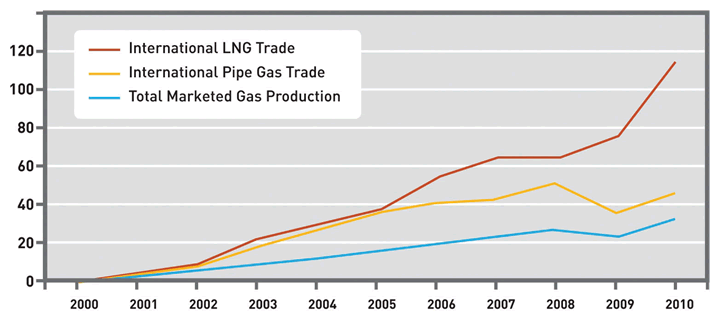
LNG trade is booming worldwide and 2011 will see volumes climb higher |
Prices of short-term LNG cargoes for Japan in early June 2011 were at around $13.50 per million British thermal units.
In the meantime, countries as diverse as Kenya in East Africa and the Baltic state of Lithuania are among the latest nations to be developing LNG import facilities and seeking suppliers.
The France-based International Group of Liquefied Natural Gas Importers (GIIGNL) has also published its annual report noting the latest trends in the industry.
That’s as the LNG carrier fleet worldwide emerges from a three-year slump and vessel owners cash in on demand for shipping for spot cargoes that has reached rates of more than $90,000 a day or more from under $40,000 in 2010.
Cargo flows
The LNG carrier fleet has also grown to more than 360 ships in 2011, with more than 30 others on order.
Due to the decline of indigenous production in mature markets and the development of new gas markets, international gas flows continued to expand, and total international gas trade increased by 10.9 percent last year compared with the previous year, the report from the importer group said.
“In this context, LNG flows recorded the largest growth with a 21 percent increase, the operational start-up of new liquefaction capacity in Qatar being the primary reason. By comparison, pipeline trade increased by 7 percent,” it added.
Recovery
Spurred by global economic recovery, this record increase was allowed by the rise of production levels from existing facilities in Qatar, Nigeria, Indonesia and Russia, as well as by the addition of new liquefaction capacity in Qatar, Yemen and Peru.
On the import side, Asian LNG markets experienced a strong recovery, up 16.8 percent after a 4 percent decline in 2009.
European imports continued to grow by 24.8 percent, with the majority of additional volumes coming from Qatar and being delivered into three countries: Italy (Rovigo), the UK (South Hook) and Turkey (Aliaga).
 |
|
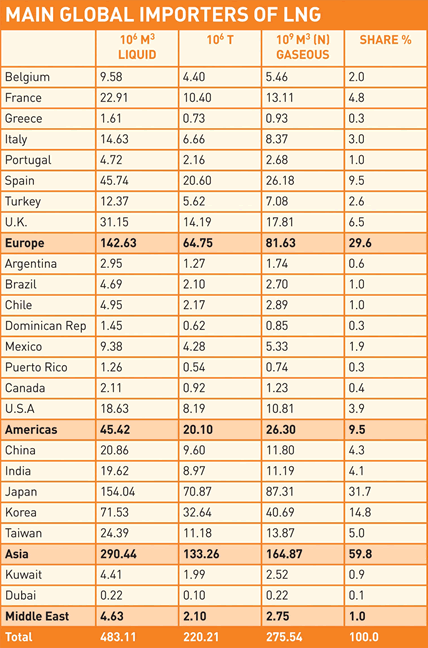
Global imports of LNG are growing as the production volumes increase |
Imports into Central and South America more than doubled because of new players such as Argentina, Brazil and Chile.
At the end of the year, Japan remained the leading LNG importer on 70.87 MT, with South Korea on 32.64 MT. Korea’s share of all imports reached 14.8 percent. Japan’s import total is likely to surge over 80 MT in 2011 because of requirements after the March disaster.
The UK is rapidly catching Spain as Europe’s largest importer. Spanish imports for 2010 were just over 20 MT and the UK was at just over 14 MT, with France in third at 10.4 MT.
Spain was still the third-largest of all importers, with 9.5 percent of global supply, halting an 8 percent decline in imports in the previous year because of the economic downturn.
India was the only Asian customer last year to reduce its appetite for LNG, as a result of growing domestic production, though still importing just under 9 MT. In the Americas, due to the rise of nonconventional domestic gas supplies, and to the low-price environment, LNG imports to the US declined to around 8 MT last year after netting out LNG re-exports.
Appetite
In contrast, the appetite for LNG in South America grew strongly, mainly as a result of gas demand for power generation.
Imports by Argentina, Brazil and Chile almost tripled compared with the previous year to more than 5.5 MT, giving them a 2.6 percent share of global supplies and more than the imports of around 4.3 MT made by established importer Mexico.
On the export side, the GIIGNL report said LNG output grew to just over 220 MT. In addition to production build-up of facilities commissioned in 2009 there was also some enhanced operational performances from existing Trains.
On a regional basis, exports from the Pacific Basin grew by 15.1 percent, allowing the region to remain the major source of LNG exports with 83.2 MT, compared with 75.6 MT from the Middle East and 61.3 MT from the Atlantic Basin.
Nevertheless, the Pacific Basin’s share of world LNG exports went down from 39.5 percent in 2009 to 37.2 percent in 2010.
Mideast
Due to Qatar’s new Trains, the Middle East contributed 33.9 percent of world exports of LNG compared with 27.9 percent in the previous year. The Atlantic Basin’s share of global production was reduced to 28.8 percent from 32.5 percent the previous year due to the reduction of exports from North Africa.
Production was boosted by countries such as Qatar, Nigeria, Russia and Indonesia, while production fell in Egypt, Algeria and Trinidad.
The Egyptians saw their LNG deliveries drop more than 30 percent due to the growth of the country’s domestic gas needs, the report added.
During 2010, Qatar was responsible for one quarter of global LNG production, exporting to all countries with import facilities except for Greece, Kuwait, Puerto Rico and the Dominican Republic.
Indonesia return
Last year also saw the return of Indonesia to second in the ranks of LNG producers, after briefly falling behind Malaysia. Fourth-ranked was Australia, followed by Nigeria.
Nigerian exports rose by 54.2 percent to 18 MT due to restored gas supplies to the Bonny island LNG plant following the restart of the Soku facility, Nigeria’s key feeder gas plant.
Spot and short-term imports, defined as contracts with a duration of four years or less, recorded a very strong increase of 40 percent and reached 727 cargoes in 2010 compared with 491 cargoes in 2009, accounting for 18.9 percent of the world LNG trade.
LNG traded under long-term contracts recorded a 17 percent increase. The rise of spot and short-term operations was particularly significant in Europe, up more than 50 percent because of attractive prices and the availability of uncommitted LNG supply from the Middle East.
After a sharp decline in 2009, Asia also experienced a renewed growth in spot and short-term purchases in 2010 and the figure is expected to be even higher by the end of 2011 because of Japan’s imports.
Spot and short-term trading of LNG last year was also marked by the growing activity of non-asset-based players, including financial institutions and oil trading companies, as well as by the significant number of re-exported cargoes, the report said.
Also during 2010 a total of 19 cargoes were reloaded (seven from Zeebrugge, eight from Sabine Pass in Louisiana and four from Freeport LNG in Texas). Nine of these were re-exported east of the Suez Canal and 10 remained in the Atlantic Basin.
Flexibility
As an illustration of the growing global flexibility of LNG cargoes, it was noted that three LNG cargoes re-exported from the US ended up in the UK, India and South Korea in January 2011.
As to the sourcing of spot and shortterm trades in 2010, Qatar overtook Trinidad and came first with a 25.7 percent share, followed by Trinidad (17.2 percent), Nigeria (12.3 percent) and Egypt (7.3 percent).
In 2010, new flexible volumes from Qatar contributed to 45.3 percent of the new spot and short-term volumes on the market, followed by Nigeria at 18.8 percent and Yemen on 12.6 percent.
Other facts disclosed by the trade body showed that world LNG trading involved 149 “flows” (i.e. country-to-country trades) over 386 sea transportation routes (port-to-port routes). Of the total 100 routes were new.
Routes
In 2010, there were 42 new country-tocountry flows: Abu-Dhabi to Brazil, China, Korea, Kuwait, Spain and Taiwan; Algeria to Chile and Japan; Egypt to Belgium, Chile and Kuwait; Equatorial Guinea to Greece, India, Italy and Kuwait; Nigeria to Kuwait and the UK; Norway to Belgium, Italy, Korea and Taiwan; Peru to Belgium, Brazil, Canada, Korea, Mexico, Spain and the US; Qatar to Argentina, Brazil, Dubai and Portugal; Trinidad to Chile and Italy; Yemen to Chile, China, France, India, Japan, Kuwait, the UK and the US.
At the end of December 2010, the number of LNG carriers under construction or on firm order was 20, of which two will have Moss tanks and the 18 others the GTT membrane tank.
Then, in the first two quarters of 2011 there were a dozen more orders placed for new-builds at Korean shipyards. In 2010, LNG traffic towards Europe via the Suez Canal soared, with a 74 percent increase compared with the previous year, the report said.
This can be explained by the addition of new imports from the Middle East and by the 30 percent discount on official transit rates granted by Egypt following Qatar’s request.
By way of comparison, the traffic of loaded oil tankers via the Suez Canal only recorded a 1.8 percent increase.
Liquefaction
There were 25 LNG liquefaction facilities in operation in 18 countries at the end of 2010. There were 94 liquefaction Trains, with the average utilization rate reaching 81 percent, compared with 74 percent the previous year. Utilization numbers have since grown during 2011.
At the Bonny Island liquefaction plant, the Nigeria LNG joint venture is currently planning the construction of a seventh treatment unit, which is expected to come on line by 2013. Regarding the Brass LNG project in Nigeria, front-end engineering operations were proceeding and the final investment decision is expected in the first quarter of 2012. The plant is expected to be completed in 2015 and it could produce up to 10 MTPA.
There were 83 LNG regasification terminals in operation at the end of 2010, including 10 floating facilities. The total send-out capacity of the facilities in operation amounted to 600 MTPA (796 Bcm of gas) compared with annual LNG consumption of 220 MTPA.
Utilization
The global average utilization rate of installations was around 37 percent last year.
The annual average utilization rate of regasification terminals is characterized by significant regional discrepancies: very low in North America (about 12 percent) due to the unforeseen development of shale gas.
However, regasification use reaches 42 percent in Asia and 50 percent in Europe, with intra-annual peaks according to the seasonal variations in demand. There were most notably start-ups, expansions and upgrades of LNG import terminals in China.
At the Dapeng terminal, the design was completed for the fifth loading arm, and a new nitrogen generation facility was being installed and commissioned. Regasification capacity per annum is now around 9 Bcm.
Investors
Kunlun Energy, a Hong Kong subsidiary of CNPC, secured a 75 percent stake in the Petrochina Dalian LNG company, the operator of the Dalian LNG terminal in China’s Northeastern Lioning province. The other shareholders of PetroChina Dalian LNG are Dalian Port (20 percent) and Dalian Construction Investments (5 percent).
The company completed the construction of a wharf capable of receiving Q-Flex LNG tankers, which will be the first phase of the 3 MTPA project. A second step which may double the terminal capacity is planned later. LNG will come from Qatar and Australia. PetroChina’s Rudong LNG terminal in China’s Eastern province of Jiangsu received its first cargo from Qatargas in 2011.
PetroChina has a 25-year supply contract with the Qatargas IV plant for 3 MTPA. At the same time Sinopec has begun construction of its Qingdao LNG terminal project in the eastern province of Shandong.
That project is scheduled to start up in 2014 with an initial import capacity of 3 MTPA, increasing to 6 MTPA. The company signed a 20-year supply contract with ExxonMobil for 2 MTPA from the PNG LNG project in Papua New Guinea.
Additionally, CNOOC has started construction at its Zhuhai terminal, its second terminal in the southern province of Guandgdong after Dapeng.
The initial capacity of 3.5 MTPA could be expanded to 12 MTPA. The terminal will receive LNG supplies from CNOOC’s long-term contracts with Qatargas and BG’s Queensland Curtis CSG-to-LNG project in Australia.
In India, Petronet LNG has started building a second jetty at the Dahej terminal to handle larger capacity LNG carriers. The company is also studying plans to build two additional storage tanks to increase terminal capacity.
The new LNG terminal in Kochi (Petronet) is expected to be commissioned at full capacity of 5 MTPA by March 2012.
At the Dabhol LNG terminal located in Maharashtra (South West of India) and operated by Ratnagiri Gas and Power, operations have been delayed due to the lack of breakwater which would only be completed this year.
Full capacity will be around 5 MTPA and three 160,000 cubic metres storage tanks will be built.
New project
Construction of a 6.5 MTPA receiving terminal is planned at Mundra in Gujarat, India. FEED has been completed and land reclamation activity is in progress.
In South Korea, the expansion of the 1.7 MTPA LNG receiving terminal in Gwangyang (Posco) was completed with the addition of a third above-ground storage tank (165,000 cubic metres). Another significant report released in early June 2011 came from the International Energy Agency.
According to the IEA, there is a “dramatic and continuing expansion of LNG trade” around the world and the trade in natural gas between regions will double to over 1 trillion cubic metres by 2035. In the IEA’s new “Gas Scenario” report, the surge in demand for LNG, shale-gas and pipeline gas is driven by: mounting worries over energy security and climate change, the renewed debate surrounding nuclear power, the North American shale-gas boom, and more significantly, lower gas prices.
Rapid growth
Gas will overtake coal before 2030 and meet one quarter of global energy demand by 2035, the IEA said. Demand will grow by 2 percent annually, compared with just 1.2 percent for total energy, the report added.
“The LNG industry is in the midst of rapid expansion, which is boosting significantly the share of LNG in global gas trade,” the IEA said. Australia is singled out as a major future producer of LNG from its 4.6 trillion cubic metres reserves of conventional gas and 420 Bcm of CSG.
“The potential CSG resource is considerably larger, possibly 10 times this amount,” the IEA said. “Moreover, much of the land mass and large offshore areas have yet to be fully explored,” the report said.
While Russia, Nigeria and Iran still had huge potential for LNG and other gas projects, no final investment decisions were imminent from those countries, the IEA report added.
“Australia is set to become the key LNG supplier in the next decade, but controlling costs (of projects) will be an ongoing challenge,” the IEA said.
An increase in global gas production equivalent to three times what is produced now by Russia will be required to meet the growth in gas demand by 2035, the IEA stated.
LNG Journal, Europe Editor




