





The Alexandroupolis LNG Terminal in Greece begins operations, boosting energy security for Southeast Europe. Despite technical challenges, it aims to diversify gas supplies and strengthen regional energy infrastructure.
The port city of Alexandroupolis in northeastern Greece has become a focal point for Central and Southeast European energy strategy with the launch of its new Liquefied Natural Gas (LNG) terminal.
This floating storage and regasification unit (FSRU) marks a significant leap forward in the region's energy landscape, commencing commercial operations after years of planning and construction.
Strategic Importance
Envisioned 15 years ago by Dimitris Copelouzos of the Copelouzos Group, the Alexandroupolis LNG Terminal was developed by the Gastrade joint venture.
The project, which took two and a half years to construct following the final investment decision in January 2022, boasts a capacity of 5.5 billion cubic metres per year.
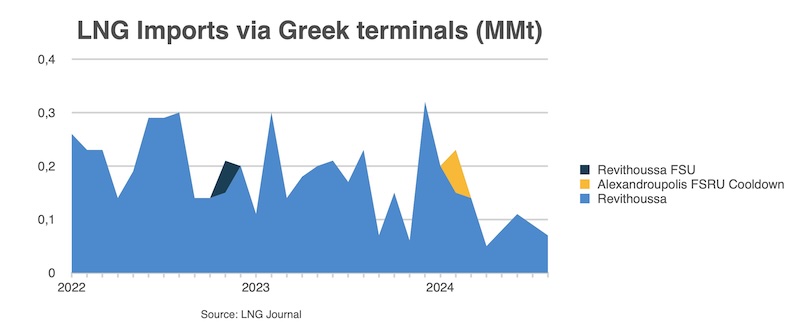
Bulgarian Energy Minister Vladimir Malinov recently emphasised the terminal's pivotal role in diversifying energy supply and bolstering regional energy security.
During a meeting with Gastrade's management and other project shareholders, Malinov confirmed that the implementation of this project should be seen as a regional priority.
The terminal is designed to enhance energy security, diversify energy sources and supply routes, and elevate Greece's role in Europe's energy map.
Apart from Greece itself, it will serve as an energy gateway for Bulgaria, North Macedonia, Serbia, Romania, Hungary, Moldova, and Ukraine.
If used to its full capacity, the terminal thus stands to significantly upgrade Greece’s importance in the European energy landscape.
Technical Challenges
The terminal comprises an FSRU along with subsea and onshore natural gas pipelines connected to Greece’s National Natural Gas Transmission System.
However, a technical defect was identified during the initial phases of connecting the FSRU to the pipeline.
With the FSRU’s cooldown cargo already delivered in February via the GasLog HongKong, the project partners were adamant, however, that the terminal would being commercial operation within the year.
At the time, Malinov also stressed the urgency of addressing the technical defect swiftly, stating, "Further delays are completely unacceptable in view of the strategic importance of the terminal for supplying energy to the region."
Market Impact
Fourteen Greek and international companies have committed to the project, with most capacity booked until at least 2030.
Five equal partners own the terminal, each holding a 20% stake: Elmina Copelouzou, GasLog, DEPA Commercial, Bulgartransgaz, and Greece's National Natural Gas System Operator (DESFA).
Bulgaria's significant stake, through Bulgartransgaz, underscores the project's international importance and collaborative nature.
Regional Significance
The Alexandroupolis LNG Terminal is also meant to strengthen the Vertical Gas Corridor (VGC) initiative, which aims to connect the gas grids of several Southeast European countries.
VGC sits alongside other regional developments such as the Revithoussa LNG Terminal and the Trans-Adriatic Pipeline (TAP).
By enabling diversified gas imports from sources such as the United States, the Alexandroupolis terminal is planned to mitigate the impact of supply disruptions and contribute to the stability and security of energy supplies in Southeastern Europe.
Crucially, it also provides new impetus to the planned expansion of the Interconnector Greece-Bulgaria (IGB) to five billion cubic metres per year and opens Greece’s locked down throughput capacity at Revithoussa to more competition.




