





Following a vote in favour of further LNG capacity expansion offshore the Baltic Island of Rügen by the German Bundestag, the island’s residents and local pressure groups have announced legal action to stop the project progressing further. The residents’ lawyer announced he intends to apply for an injunction based on insufficient risk assessments. Meanwhile, the German government insists LNG capacity expansions remain necessary to avoid a potential gas shortfall in the coming winter.
In mid-June, Germany’s Deutsche ReGas announced in a statement it would be launching the Binding Open Season for Phase II of its ‘Deutsche Ostsee’ LNG terminal at the end of June.
Phase II involves, among other things, the installation of a second FSRU. However, Deutsche ReGas has not yet specified which vessel would take that role.
Legal action
Now, the German resort town of Binz said it will take legal action at the federal administrative court in Leipzig against further construction of LNG terminals off the Baltic Sea coast on Friday last week.
The town’s lawyer, Rainer Geulen, told the German daily Ostseezeitung that he would base his request for an injunction on an absent or insufficient risk assessment for the two terminals as mandated by EU law.
He also asserted that it would be impossible to complete construction in time for the two terminals to have a meaningful impact during the winter of 2024.
Carrying on
The German Bundestag voted in favour of the accelerated construction of two LNG floating terminals off Mukran on the Baltic Island of Rügen, according to its website.
The Government justified the vote with the enduring risk of winter cold snaps, which could result in gas shortages without additional import capacity.
The vote took place despite resistance from local governments and environmental groups, who fear detrimental impacts on tourism and marine life.
New German pace
As we have reported previously, the German parliament passed a reform bill to speed up the process last year.
The recognition of a pressing need to quickly install alternative gas import infrastructure after the sharp decline in EU imports of Russian pipeline gas produced a new German LNG acceleration law and a ‘New German Pace’, whereby the typically lengthy regulatory path was eased for several LNG projects.
According to the local mining administration in Stralsund, an application for pipeline construction by pipeline specialist GASCADE has been lodged with a four-week consultation period beginning on 17 July.
Together with terminal operator Deutsche ReGas, GASCADE has been instrumental in developing the ‘Deutsche Ostsee’ terminal at the small industrial port of Lubmin, the only LNG terminal on Germany’s Baltic coast at the time of writing.
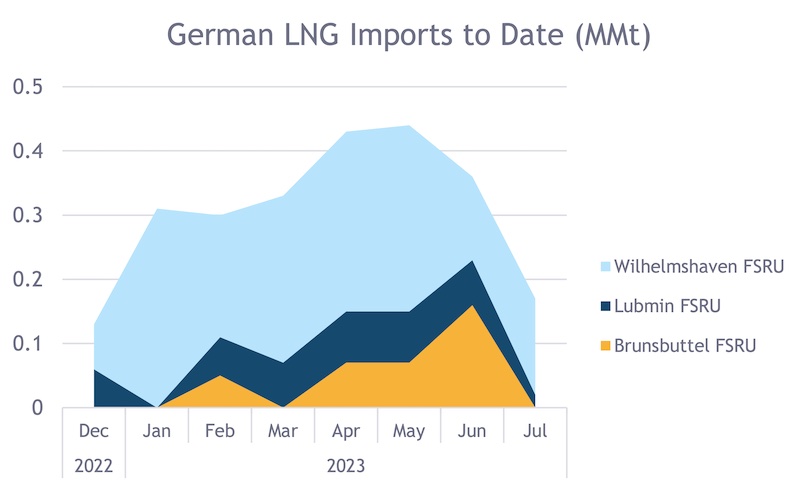
Direct LNG deliveries to Germany have amounted to 2.30mmt, our data showed at the time of writing.




