





The Northern Territory Government in Australia has completed scientific inquiries about hydraulic fracturing for shale gas and has put in place a regulatory regime for exploration, opening a new phase of energy activities in the nation that has become the world No. 1 LNG exporter.
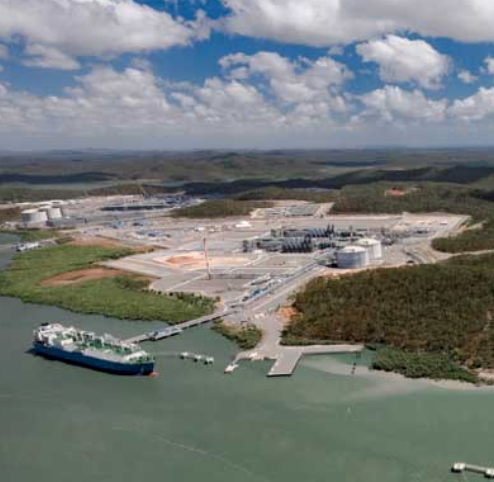 |
One of the companies at the forefront of Australian LNG, Santos, is operator of the Gladstone coal-seam-gas-to-LNG plant in Queensland, has a stake in the Darwin LNG plant in the Northern Territory operated by ConocoPhillips and is part of the expansion plans for LNG in Papua New Guinea.
The Santos shale-gas ambitions, its Australian LNG plans and the latest on the Papua New Guinea expansion were outlined on May 2 at the company’s annual shareholder meeting in Adelaide.
These include the first moves by the Australian energy company to start shale-gas exploration in the McArthur Basin in the Northern Territory.
“With the new regulatory regime for exploration now in place, applications to enable the drilling of two new exploration wells in the McArthur Basin later this year have been submitted,” said Santos Chief Executive Kevin Gallagher.
“The McArthur Basin is the largest and most promising shale-gas opportunity in Australia - and the Northern Territory desperately needs the economic opportunity that would come with its development,” the CEO told his shareholders.
“With no less than 14 scientific inquiries confirming this can happen safely and without harm to the environment or water resources, the imperative of unlocking economic opportunity for Territorians, combined with growing demand for cleaner, reliable and affordable energy in both Australia and Asia speaks for itself,” stated Gallagher.
The CEO also noted that in northern Australia, the Darwin LNG plant performance was again strong with LNG production up on 2017 despite a planned shutdown.
The three-well Bayu Undan infill programme was delivered 40 percent under budget and the final well was brought on stream more than three months ahead of schedule, with higher liquids production.
As efforts continue to lengthen the lifespan of the Darwin LNG plant, which exports to Japan and has been on stream since 2006, Gallagher said his company was making good progress on offshore Barossa gas field development as the lead candidate to backfill the Darwin plant.
He added that an engineering, procurement and construction contract for the subsea production system would be awarded soon.
A production licence application for the Barossa project has been made ahead of a final investment decision next year and successful development would extend the operating life of the ConocoPhillips-operated Darwin plant by more than 20 years.
This would more than double the Santos production levels in northern Australia, and with shale-gas still to come.
The Santos CEO also said that Papua New Guinea LNG production has been restored to earlier levels following last year’s earthquake.
“Plant upgrades resulted in record daily production rates equivalent to 9.2 million tonnes per annum in the second half last year and this strong performance continued in the first quarter this year,” said Gallagher.
The CEO stated that PNG LNG expansion opportunities continued to be progressed with a proposal for Santos to farm-in to the P’nyang gas field under negotiation.
“We continue to work with our operator and joint venture partners to achieve alignment on LNG expansion plans,” he said.
“Following the success of the Barikewa-3 appraisal well, the Muruk-2 result this year confirmed the field is a significant gas discovery with the potential to support PNG LNG backfill or expansion,” he explained.
In reference to the Gladstone LNG plant in Queensland, Santos said it was on track to meet sales target as it ramped up to 6 million tonnes of LNG sales per annum by the end of 2019.
The CEO said there had been “excellent progress” with the CSG upstream resources and in exploration.
The GLNG project had delivery of the Scotia volumes a year ahead of schedule and sanctioned the 480-well Roma East field development where first gas has already been delivered.
A further 148 CSG wells are part of the Arcadia development and the first wells were now coming on stream
“I am also pleased to say that our eastern Queensland fields are increasingly freeing up more Cooper Basin gas for the domestic market,” said Gallagher.
“GLNG still has a lot of potential and we are working with our partners to access and utilise spare capacity as supply volumes become available,” he added.
“Importantly we are also focused on serving the domestic gas market, securing domestic-gas-only acreage near Roma in our first joint venture with Shell,” he explained.
“Exploration will target deep, conventional sandstone reservoirs and I am very pleased that Santos will be the operator to develop these blocks exclusively for the domestic market because low-cost supply is the best way to deliver competitive gas prices for customers,” said the CEO.




