





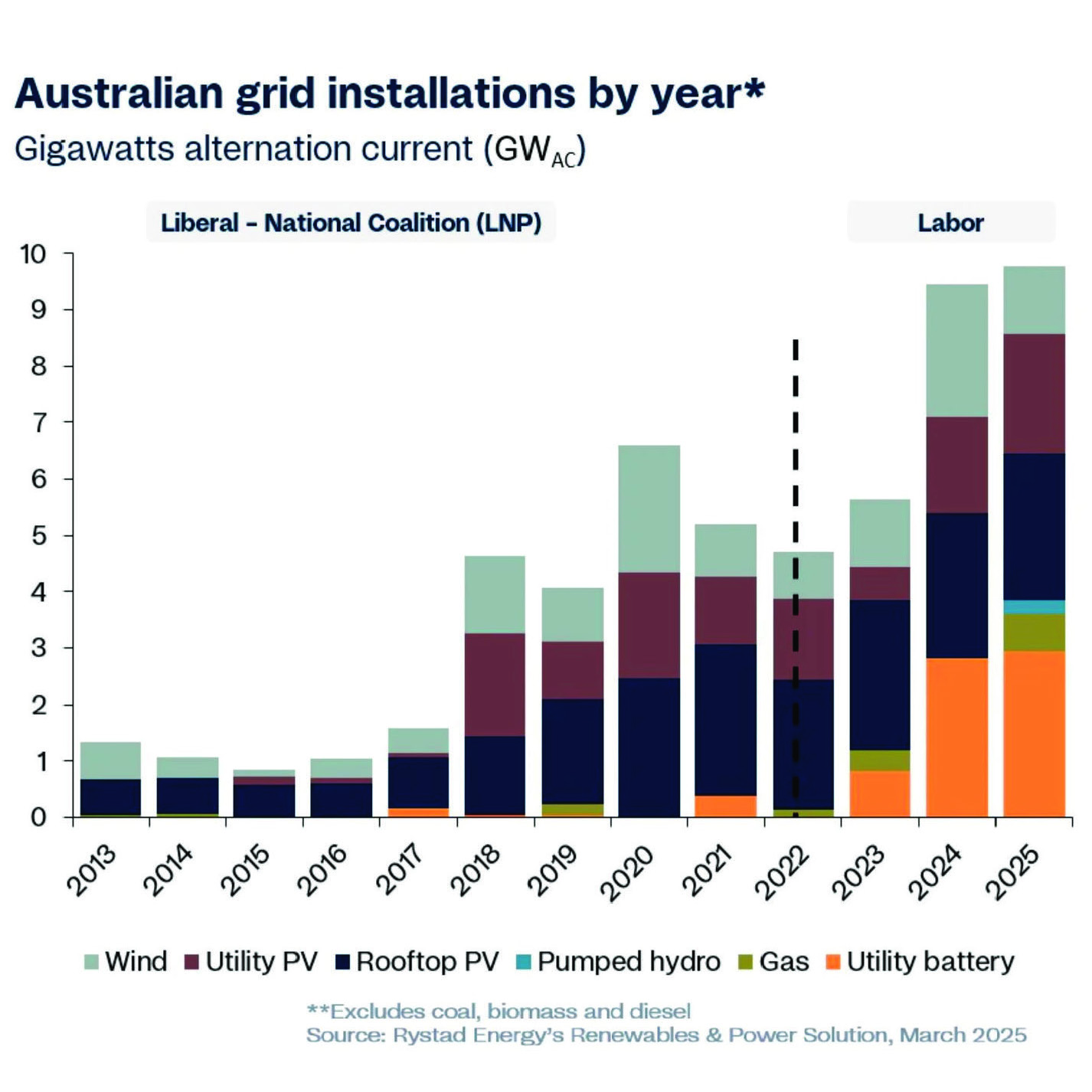
A substantial 13 GW of nuclear capacity built by 2051 is meant to replace coal generation in Australia, if the Liberal National Party (LNP) wins the federal election in early May. The incumbent Labor government targets 82% renewable energy – though short-term grid stability hinges on dispatchable gas power plants, partly fuelled by imported LNG.
 |
Shipping uncontracted LNG from northern Australia to southern states is paramount to avert a power crunch. Domestic gas demand has for long clashed with LNG export ambitions of the likes of Santos, Woodside, Orgin Energy and BG Group.
Yet LNG imports may soon be called for, the Australian Energy Market Operator (AEMO) warns as gas output in southern Australia stands to dwindle by 40% from 1,260 Terajoule per day (TJ/d) currently to just 740 TJ/d in 2028.
New South Wales (NSW), Australia’s most densely populated state, already relies largely on the ExxonMobil-operated Gippsland basin joint venture for gas supply and a part closure of the 1,150 TJ/d Longford facility earlier this year exacerbated supply risks.
Several FSRUs lined up
Several prospective import projects are taking shape: The Outer Harbor FSRU, for starters, is an LNG import terminal under construction in Australia, close to the Pelican Point gas-fired power station in Port Adelaide. Venice Energy, the project owner, is partnering with AG&G LNG and GAS Entec for the delivery of a converted floating regas unit with a capacity of 1.1 mtpa.
Squandron Energy, meanwhile, announced its 2.4 mtpa Port Kembla Energy Terminal in NSW is ready to enter operations on Dharawal land. Developers said the terminals will have the capacity to supply 500 TJ/d – enough to meet nearly all of NSW’s gas needs on a peak day. Analysts reckon the terminal could cover the states entire winter demand of roughly 481 TJ/d, excluding gas-fired generation.
Yet, despite completion, LNG shipments are not scheduled to arrive until early 2026 when the designated FSRU, Höegh Galleon, will make its way to Port Kembla. This timeline aligns with projections of the Australian Competition and Consumer Commission which anticipates gas shortages in the eastern states from early next year. Hoegh Galleon FSRU would be utilized for the terminal under a 15-year contract. Commissioning and start-up had to be pushed back to the second quarter of 2026, to secure sufficient demand for the terminal’s capacity.
Re-jigging contracts
Down-under, as Australia is colloquially called, the energy landscape is in disarray. Upstream majors seek to renegotiate contracts for LNG exports and domestic gas sales with a view to securing a more equitable share of profits and reinvesting a part of them in renewable technologies. According to Andrew Dyhin, principal consultant at CHATO, “this strategy mirrors how Middle Eastern countries have leveraged oil wealth to diversify and build sustainable economies.”
The cost of imported LNG is, however, up to 25% higher than pipeline gas, especially in the winter season: The AVX, Argus' assessment for month-ahead spot gas deliveries to Victoria, averaged A$12.46/GJ in late December – while the Gladstone FOB price, a netback indicator calculated by subtracting freight and production costs from the delivered price of LNG in Asia-Pacific — averaged A$16.03/GJ for the same period.




