

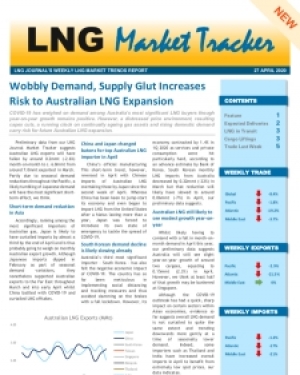
Wobbly Demand, Supply Glut Increases Risk to Australian LNG Expansion
COVID-19 has weighed on demand among Australia’s most significant LNG buyers though year-on-year growth remains positive. However, a distressed price environment, resulting capex cuts, a running clock on continually ageing gas assets and rising domestic demand carry risk for future Australian LNG expansion.
Preliminary data from our LNG Journal Market Tracker suggests Australian LNG exports will have fallen by around 0.2mmt (-2.6%) month-on-month to c. 6.8mmt from around 7.0mmt exported in March. Partly due to seasonal demand reductions throughout the Pacific, a likely tumbling of Japanese demand will have the most significant short-term effect, we think.
Short-term demand reduction in Asia
Accordingly, ranking among the most significant importers of Australian gas, Japan is likely to have curtailed imports by almost a third by the end of April and is thus probably going to weigh on monthly Australian export growth. Although Japanese imports dipped in February as part of seasonal demand variations, they nonetheless supported Australian exports to the Far East throughout March and into early April whilst China battled with COVID-19 and curtailed LNG offtakes.

China and Japan changed batons for top Australian LNG importer in April
This short-term trend, however, reversed in April with Chinese imports of Australian LNG overtaking those by Japan since the second week of April. Whereas China has been keen to jump-start its economy and even began to import LNG from the United States after a hiatus lasting more than a year, Japan was forced to introduce its own state of emergency to tackle the spread of COVID-19.
South Korean demand decline is likely slowing already
Australia’s third most significant importer – South Korea – has also felt the negative economic impact of COVID-19. The country has so far been meticulous in implementing social distancing and tracking measures and thus avoided slamming on the brakes with a full lockdown. However, its economy contracted by 1.4% in 1Q 2020 as services and private consumption were hit particularly hard, according to an advance estimate by Bank of Korea. South Korean monthly LNG imports from Australia decreased by 0.22mmt (-22%) in March but that reduction will likely have slowed to around 0.06mmt (-7%) in April, our preliminary data suggests.
Australian LNG still likely to see modest growth year-on-year
Whilst likely having to contend with a fall in month-on-month demand in April this year, our preliminary data suggests Australia will still see slight year-on-year growth of around two cargoes, equating to 0.15mmt (2.3%) in April. However, we think at least half of that growth may be bunkered at Singapore.
Although the COVID-19 outbreak has had a quick, sharp impact on certain sectors within Asian economies, evidence so far suggests overall LNG demand is not curtailed to quite the same extent and trending downwards more gently at a time of seasonally lower demand. Indeed, some importers such as Thailand and India have increased overall imports in April to benefit from extremely low spot prices, our data indicates.
Prevailing supply glut leads to CAPEX reductions
Instead, the prevailing supply glut outstripping current demand growth and a weaker global economic outlook for the remainder of the year is set to have a more profound impact on Australian LNG, in our view. Rather than low prices alone – we expect the majority of contracted Australian LNG to have been hedged at floor prices significantly above Brent’s current sub-$20/bbl range – operators are deferring final investment decisions (FID) and curtailing CAPEX with potential repercussions on future Australian gas production.
“Growth projects deferred until business conditions improve”
Notably, Santos slashed its 2020 capex budget by 38% and delayed FID for the Barossa offshore development until further notice. Gas from Barossa was previously earmarked to secure feedgas supply to the Darwin LNG plant, which is currently dependent on the ageing Bayu-Undan field discovered in 1995.
Fellow Australian LNG producer Woodside has also announced a CAPEX cutback of 62%, including deferral of the planned Scarborough and Browse developments as well as a second train at Pluto LNG. Japan’s INPEX also indicated it will be cutting expenditure.
Domestic competition
Concurrently, Australian LNG is facing growing competition not just for markets abroad, but also feedgas domestically, a March report by Australia’s independent Energy Market Operator suggests. It highlights that existing and committed gas developments would be sufficient to meet domestic east coast demand until 2023 but that additional sources of gas supply are required to address a potential shortfall from 2024. Since its inception, LNG capacity in Queensland in particular has had to contend with public backlash for not seemingly prioritising domestic supply over exports.
Consequently, we see three LNG growth constraints pulling in different directions in Australia at the moment – current and imminent capex reduction announcements, the clock running on ageing gas assets (likely hastened if less drilling investment) and domestic demand growth with its potential for political pressure if growth exceeds supply and increases domestic prices. These factors embody a much more profound risk to future LNG capacity expansions in Australia than COVID-19, in our view, as their combined effect is potentially far-reaching.
Market Tracker - April 28, 2020
Click to Download
Gas to Power - April 24, 2020

Click to Download
Gas to Power - April 17, 2020
Click to Download
Monthly Data - April 2020
Click to Download
April 2020 Monthly Market Overview
Global conventional LNG trade saw a notable increase in March, growing by 1.45mmt to 33.90mmt (4.5%) from the 32.45mmt seen in February. Accordingly, trade performance in March 2020 marks an increase of 2.38mmt over 2019, equating to 7.5% year-on-year growth. At the time of writing, 2.73mmt (8%) of the exported 33.90mmt in March remain to be delivered; their current delivery horizon is 25 May.
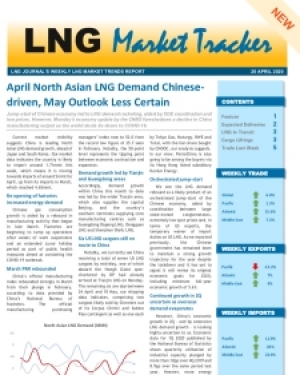
April’s North Asian Demand Chinese-driven, but May Outlook Less Certain
Jump-start of Chinese economy led to LNG demand rocketing over the past two weeks, aided by SOE coordination and low prices. However, Monday’s economy update by the CNBS foreshadows a decline in China manufacturing output as the world shuts its doors to COVID-19.
Market Tracker - April 20, 2020
Click to Download
Market Tracker - April 13, 2020
Click to Download
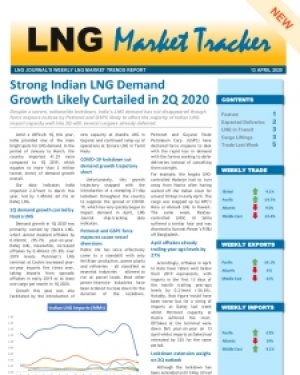
Strong Indian LNG Demand Growth Likely Curtailed in 2Q 2020
Despite a severe, nationwide lockdown, India’s LNG demand has not disappeared though force majeure notices by Petronet and Gujarat State Petroleum Corp. likely affect the majority of Indian LNG import capacity well into 2Q with several cargoes already deferred.
Amid a difficult 1Q this year, India provided one of the main bright spots for LNG demand. In the period of January to March, the country imported 41.2% more compared to 1Q 2019, which equates to more than 2 million tonnes (mmt) of demand growth overall.
Our data indicates India imported 2.37mmt in March this year, led by 1.45mmt (61.1%) at Dahej LNG.
1Q demand growth carried by Hazira LNG
Demand growth in 1Q 2020 was primarily carried by Hazira LNG, which almost doubled offtakes by 0.43mmt (95.7%) year-on-year. Dahej LNG, meanwhile, increased offtakes by 0.40mmt (51.8%) over 2019 levels. Petronet’s LNG terminal at Cochin increased year-on-year imports five times over, taking imports from sporadic offtakes in early 2019 to at least one cargo per month in 1Q 2020.
Growth this year was also facilitated by the introduction of new capacity at Mundra LNG in Gujarat and continued ramp-up of operations at Ennore LNG in Tamil Nadu.

COVID-19 lockdown cut demand growth trajectory short
Unfortunately, this growth trajectory snapped with the introduction of a sweeping 21-day lockdown throughout the country to suppress the spread of COVID-19, which has very quickly begun to impact demand in April, LNG Journal ship-tracking data indicates.
Petronet and GSPC force majeures cause vessel diversions
Public life has since effectively come to a standstill with only fertiliser production, power plants and refineries – all classified as essential industries – allowed to run at parcel loads. Most other power-intensive industries have been ordered to close down for the duration of the lockdown. Petronet and Gujarat State Petroleum Corp. (GSPC) have declared force majeure to deal with the rapid loss in demand with the former seeking to defer deliveries instead of cancelling them outright.
For example, the Angola LNG-controlled Malanje had to turn away from Hazira after having waited off the Indian coast for around 10 days in early April. The cargo was snapped up by KPC’s Mina al Ahmadi LNG in Kuwait. The same week, RasGas-controlled LNGC Al Sahla suffered a similar fate and was diverted to Summit Power’s FSRU off Bangladesh.
April offtakes already trailing year-ago levels by 27%
Accordingly, offtakes in April to date have fallen well below their 2019 equivalents, with imports in the first 13 days of the month trailing year-ago levels by 0.21mmt (-26.6%). Notably, that figure would have been worse but for a string of imports at Dahej last week whilst Petronet capacity at Hazira suffered the most. Offtakes at the terminal were down 56% year-on-year on 13 April whilst imports at Dahej had retreated by 32% for the same period.
Lockdown extension weighs on 2Q outlook
Although the lockdown has been extended until 3 May (it had previously been planned to end on Tuesday), New Delhi advised it will likely permit economic activities to resume in COVID-19 free zones starting 20 April to aid poorer people dependent upon daily wages. However, this is unlikely to translate into a full-throttle resumption of heavy industry and consequently LNG demand, in our view, as it will take time for the labour force to return to their industrial sites often far away from home villages. As such, we do not yet see a silver lining for Indian demand in Q2 2020.